
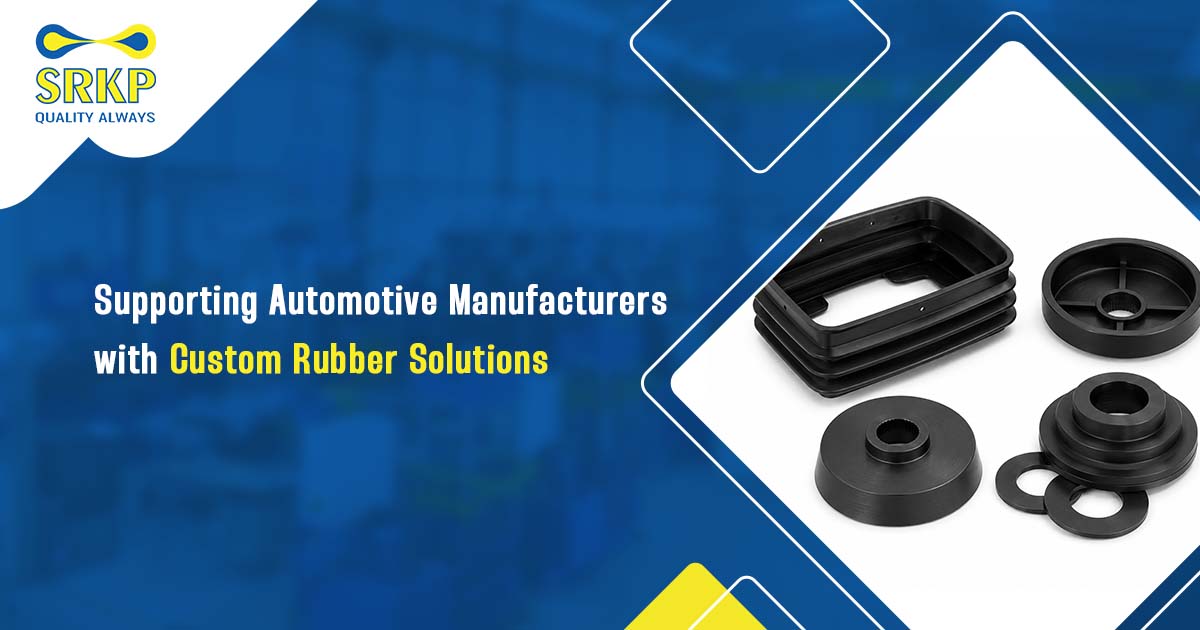
Custom Rubber Solutions for the Automotive Industry
Every vehicle on the road relies on dozens of rubber components working silently in the background. From a two-wheeler commuting through city traffic to a heavy-duty commercial truck navigating the highway, these parts absorb vibration, prevent fluid leaks, protect wiring, and seal critical assemblies. Furthermore, they often operate under extreme heat, pressure, and chemical exposure that would damage lower-quality materials within weeks.
For automotive OEMs (Original Equipment Manufacturers) and Tier-1 suppliers, the challenge is not simply finding a rubber part. Instead, it is finding the right custom rubber solution made to exact specifications, from a partner who understands both the material science and the demands of the automotive supply chain.
What Are Custom Rubber Solutions in the Automotive Industry?
Custom rubber solutions are rubber components that are built and manufactured to meet the specific design, material, and performance needs of a particular vehicle application. In other words, they are not off-the-shelf standard parts.
In the automotive industry, custom rubber parts are essential for three key reasons:
- No two vehicle platforms are identical. Engine compartments, suspension layouts, and sealing environments vary significantly across models.
- Performance standards are non-negotiable. Automotive-grade rubber components must meet strict OEM quality standards, often referencing international specifications.
- Material selection is application-specific. For example, a rubber compound that performs well in a coolant hose environment may fail entirely as a fuel system seal.
Common Custom Rubber Components Used in Automotive Applications
- Seals and O-Rings — prevent fluid and gas leakage across engine, transmission, and braking systems
- Gaskets — form pressure-tight interfaces between mating metal surfaces
- Bushings and Mounting Bushes — absorb vibration and provide flexible, durable connections in suspension and engine mount systems
- Bellows and Dust Covers — protect joints and shafts from contamination, moisture, and debris
- Grommets — provide cable and wire protection where harnesses pass through metal panels
- Diaphragms — enable controlled movement in fuel delivery, braking, and emissions systems
Why Automotive OEMs Cannot Compromise on Rubber Component Quality
What happens when a rubber component fails in a vehicle? This is one of the most important questions automotive procurement engineers should be asking. The consequences of a failed rubber component extend far beyond the part itself:
- A worn engine mount bush sends too much vibration into the cabin, leading to driver fatigue and customer complaints.
- A damaged seal in a power steering system can cause sudden fluid loss, creating a serious safety risk.
- A cracked bellows on a CV joint allows grease to escape and lets contaminants in, speeding up joint wear and potentially causing drivetrain failure.
- A leaking fuel system gasket creates fire hazard conditions.
The Financial Stakes Are High
Beyond safety, the financial impact is equally significant. Warranty claims, recalls, and supply disruptions caused by low-quality rubber components carry enormous costs for automotive manufacturers. As a result, leading OEMs insist on working with rubber component manufacturers who maintain strict quality systems from raw material selection through to final delivery.
How to Select the Right Rubber Material for Automotive Applications
One of the most technically complex decisions in automotive rubber component design is choosing the right elastomer. Different rubber compounds offer very different performance profiles. Therefore, matching the right material to the right application is a core skill that sets expert rubber manufacturers apart from basic suppliers.
Commonly Used Elastomers in Automotive Rubber Solutions
| Elastomer | Key Properties | Typical Automotive Applications |
|---|---|---|
| NBR (Nitrile) | Excellent oil and fuel resistance | Fuel system seals, O-rings, gaskets |
| EPDM | Outstanding heat and weather resistance | Coolant hoses, weather seals, bellows, dust covers |
| NR (Natural Rubber) | High elasticity, excellent dynamic properties | Engine mounts, suspension bushings |
| CR (Neoprene) | Good weather, ozone, and chemical resistance | Air intake seals, hose connectors |
| FKM (Viton) | Exceptional heat and chemical resistance | High-temperature seals, turbocharger components |
| Silicone | Wide temperature range, biocompatibility | Thermal management seals, high-temp applications |
| HNBR | Enhanced heat and oil resistance vs standard NBR | Timing belt covers, high-temp fuel contact seals |
Why Compound Selection Goes Beyond a Datasheet
Selecting the correct compound requires more than matching a datasheet. SRKP’s in-house rubber compounding team evaluates the full service environment, temperature cycling, chemical exposure, mechanical stress, and regulatory requirements, before recommending a formulation. Over our 35+ years of operation, we have successfully developed thousands of unique compound recipes.
Explore our Material Specification library on the SRKP website for detailed compound profiles.
What Rubber Moulding Processes Are Used for Automotive Parts?
The manufacturing process used to produce a rubber component significantly affects its dimensional accuracy, surface quality, production speed, and cost. Moreover, choosing the right process for the right part is essential. SRKP uses multiple moulding technologies to match the process to the part.
Compression Moulding
Compression moulding is the foundational process for rubber component manufacturing. A pre-measured rubber preform is placed into a heated mould cavity. Then, press pressure causes the material to flow and fill the cavity shape. This method is well-suited to medium-to-large components with moderate complexity and remains a highly cost-effective option for many automotive applications.
Transfer Injection Moulding
Transfer injection moulding is a variation of compression moulding where pre-softened rubber compound is injected from a transfer pot into closed mould cavities. As a result, this process delivers better dimensional consistency and is particularly effective for components requiring tighter tolerances.
Injection Moulding
In injection moulding, rubber is heated and injected under high pressure directly into a closed mould. This method offers the highest process control, fastest cycle times, and is ideal for high-volume production of precision automotive components. Consequently, SRKP’s injection moulding infrastructure supports efficient, repeatable production at scale.
Learn more about SRKP’s moulding infrastructure and capabilities.
Metal-to-Rubber and Fabric-Reinforced Components
Many automotive applications demand more than a simple rubber part. For instance, components such as suspension bushings, engine mounts, and diaphragms often require rubber bonded to metal or fabric to achieve the right combination of rigidity, flexibility, and durability.
Metal-to-Rubber Bonding
SRKP specialises in bonding rubber to metal using a combination of surface preparation, adhesive chemistry, and vulcanisation. This process allows automotive components to combine the load-bearing strength of metal with the damping and sealing properties of rubber. As a result, it is essential for anti-vibration mounts, torque rods, and stabiliser bar bushings.
Fabric-Impregnated Diaphragms
Reinforcing rubber with woven fabrics creates composite components with significantly higher pressure and fatigue resistance. These fabric-reinforced diaphragms are widely used in automotive braking, fuel, and emission control systems where repeated loading demands a stronger structure.
Plastic-to-Rubber and Teflon-to-Rubber Bonding
For applications that combine sealing performance with structural needs, SRKP also offers rubber bonded to engineering plastics and PTFE (Teflon). This supports the development of integrated sealing assemblies for modern vehicle platforms.
Read more about our bonding validation processes to understand how SRKP checks bond integrity before components reach the production line.
What Quality Standards Should Automotive Rubber Suppliers Meet?
Automotive manufacturers operate within some of the strictest quality frameworks of any industry. Therefore, when evaluating a custom rubber solutions supplier, procurement teams should confirm the following:
- ISO Certification — SRKP holds ISO certification, showing a structured quality management approach across all manufacturing processes.
- In-House Testing Laboratory — the ability to test physical, chemical, and mechanical properties internally enables faster development cycles and real-time quality monitoring. SRKP’s lab supports comprehensive material and component testing.
- Six Sigma Quality Disciplines — statistical process control from raw material receipt to finished goods dispatch reduces variation and lowers defect rates.
- ZED Certification (Zero Defect) — SRKP has been awarded the ZED Silver certification under India’s MSME scheme, reflecting its commitment to zero-defect manufacturing.
- UL Certification (NSF 61) — relevant for components used in fluid-contact applications.
- R&D Capability — a dedicated research and development function is essential for suppliers supporting new vehicle platform development. SRKP’s R&D team guides customers from prototype through to series production.
Common Rubber Testing Methods for Automotive Parts
| Test | Purpose |
|---|---|
| Hardness (Shore A/D) | Confirms compound stiffness meets specification |
| Tensile Strength & Elongation | Validates structural integrity |
| Compression Set | Measures long-term sealing performance |
| Fluid Immersion Testing | Confirms chemical resistance in service environment |
| Heat Ageing | Simulates long-term thermal breakdown |
| Ozone Resistance | Evaluates susceptibility to environmental cracking |
| Bonding Peel/Shear Test | Validates metal-to-rubber adhesion strength |
How Does SRKP Support Automotive OEMs from Prototype to Production?
One of the most common concerns automotive engineers raise when considering a new rubber component supplier is consistency across the development process. Fortunately, SRKP’s development model is built to provide end-to-end support.
Design Consultation and Application Engineering
Our rubber technologists engage early in the design process to advise on compound selection, geometry optimisation, and mould design. This early involvement helps OEM teams avoid costly design revisions later in the programme.
Tooling and Mould Development
SRKP maintains in-house tooling and design capability, enabling rapid mould development and iteration. As a result, this shortens development lead times compared to suppliers who rely entirely on external tooling partners. Explore our tooling and design infrastructure.
Prototype Manufacturing and Testing
Prototypes are produced and subjected to full in-house testing before submission to the customer. SRKP’s laboratory validates key performance parameters against OEM-specified requirements.
Process Validation and PPAP Support
Production Part Approval Process (PPAP) documentation is prepared with detailed process capability data, supporting smooth approval through the customer’s quality systems.
High-Volume Series Production
Once approved, SRKP’s manufacturing infrastructure supports high-volume production with consistent quality. Additionally, our Just-In-Time inventory system ensures on-time delivery even for demanding automotive supply schedules.
Continuous Improvement
SRKP’s Six Sigma-based quality culture drives ongoing reduction in variation and PPM defect rates, something multiple automotive customers have highlighted in their testimonials.
Why Custom Rubber Solutions Are Growing in Importance
The global automotive industry is going through major changes. Electrification, lightweighting, and stricter emissions regulations are reshaping vehicle designs and the component requirements within them. For rubber solutions, this creates both challenges and opportunities.
Key Trends Driving Demand
- Electric vehicles (EVs) introduce new thermal management requirements for battery systems. Consequently, rubber compounds with enhanced heat resistance and electrical insulating properties are now in high demand.
- Lightweighting initiatives are increasing the use of composite and bonded rubber-metal assemblies to replace heavier structural components.
- ADAS and connected vehicle systems require precision rubber grommets and seals that provide reliable electromagnetic shielding and environmental protection for sensitive electronics.
How SRKP Is Prepared
SRKP’s R&D capability and in-house compounding setup position us to adapt our custom rubber solutions to these changing needs. As a result, our automotive customers can rely on us as their vehicle platforms continue to evolve.
For an external perspective on rubber compound properties and automotive material standards, the Rubber Manufacturers Association (now part of the US Tire Manufacturers Association) provides publicly accessible technical guidelines on elastomer performance criteria.
Conclusion
For automotive manufacturers, selecting a rubber component supplier is not simply a procurement decision. it is an engineering partnership. The right partner brings material science expertise, process capability, quality discipline, and responsive communication together under one roof. Ultimately, this enables your team to meet programme milestones and deliver vehicles that perform reliably in the real world.

 PPTS
PPTS