
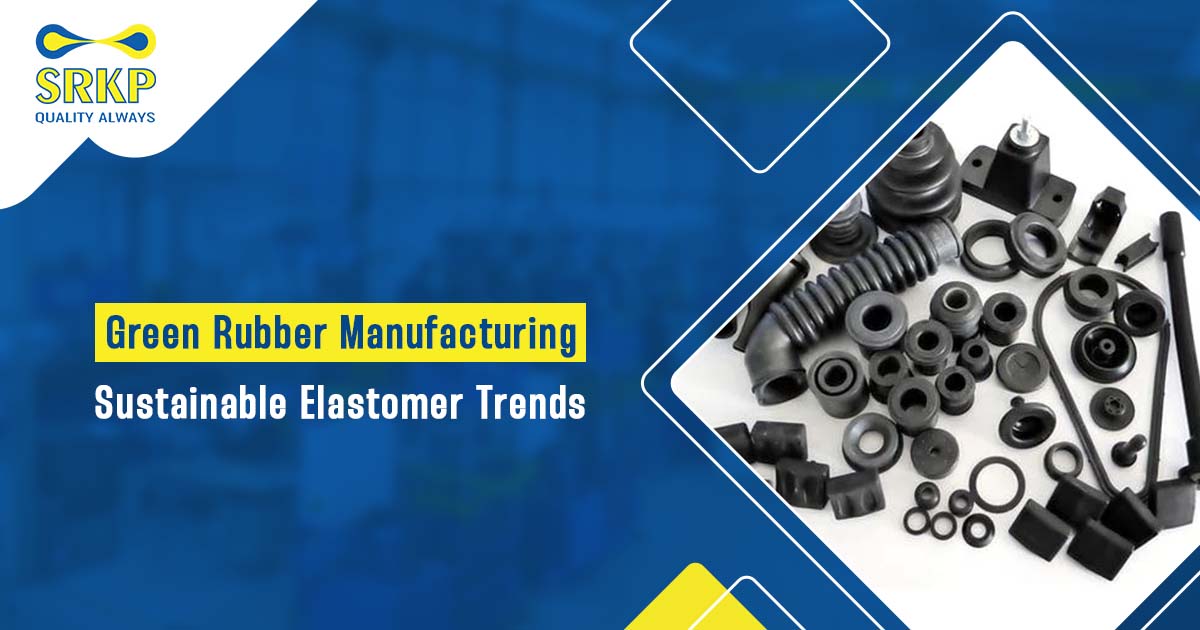
Introduction: Why Green Rubber Is No Longer Optional
When procurement managers at automotive OEMs or aerospace contractors evaluate rubber component suppliers today, one of the first questions is no longer just “what’s the lead time?” It’s “what’s your sustainability footprint?”
The global elastomer market is worth over $60 billion, and a fast-growing slice of that market is moving toward bio-based, recycled, and low-emission alternatives. Regulatory pressure from the European Union’s Green Deal, India’s Extended Producer Responsibility (EPR) framework, and carbon disclosure requirements from global supply chains are reshaping how rubber is formulated, processed, and supplied.
For industrial buyers, engineers, and procurement heads, understanding sustainable elastomer trends isn’t just about environmental stewardship, it’s about supply chain resilience, future-proofing product specifications, and meeting increasingly stringent customer requirements.
This blog covers what green rubber manufacturing means in practice, the key elastomer innovations driving the trend, and how manufacturers like SRKP are positioning to meet these evolving demands.
What Does “Green Rubber Manufacturing” Actually Mean?
The term “green rubber” is broad, and sometimes misused. For a rubber manufacturer to legitimately claim sustainable operations, it typically involves multiple dimensions:
Sustainable Raw Material Sourcing
Natural rubber (NR) remains one of the most important elastomers globally, but conventional sourcing practices have raised deforestation and biodiversity concerns. Sustainable sourcing means:
- Certified natural rubber from responsibly managed plantations (FSC or RSPO-aligned standards)
- Reduced dependency on petroleum-derived synthetic rubbers
- Integration of bio-based fillers and process oils
Green Formulation Chemistry
Traditional rubber compounds often include ingredients like aromatic process oils (containing polycyclic aromatic hydrocarbons or PAHs), lead-based stabilizers, and carbon black derived from fossil fuels. Green formulation replaces these with:
- REACH-compliant, non-toxic plasticizers and extenders
- Precipitated silica as a partial substitute for carbon black
- Zinc oxide reduction strategies (ZnO is under regulatory scrutiny in Europe)
- Sulphur-efficient vulcanization systems to reduce waste heat
Energy-Efficient Processing
Mixing, moulding, and curing all consume significant energy. Green manufacturing looks at:
- Optimized mixing cycles to reduce energy per kilogram of compound
- Heat recovery from vulcanization presses
- Solar and renewable energy integration in plant operations
- ISO 50001 energy management systems
Waste Reduction and Circularity
Flash, trimmings, and off-spec parts are inherent to rubber moulding. Sustainable operations aim to:
- Reclaim and recycle uncured compound waste
- Use devulcanization technologies to recycle cured rubber
- Achieve zero-landfill certifications
Responsible End-of-Life Management
This includes designing products for disassembly, using recyclable elastomers, and participating in take-back or EPR programmes.
Key Sustainable Elastomer Trends in 2025 and Beyond
Bio-Based Synthetic Rubbers
One of the most exciting developments in the industry is the emergence of bio-based synthetic elastomers. Traditionally, synthetic rubbers like SBR (Styrene-Butadiene Rubber), NBR (Nitrile Butadiene Rubber), and EPDM (Ethylene Propylene Diene Monomer) are derived from petrochemical feedstocks. Researchers and material scientists are now producing monomers from:
- Sugarcane and corn starch (bio-butadiene, bio-isoprene)
- Vegetable oils (bio-based plasticizers for EPDM and NR compounds)
- Lignin (as a reinforcing filler and potential carbon black substitute)
Companies like Michelin and LANXESS have already announced pilot programmes for bio-sourced synthetic rubber. While commercial-scale availability is still limited, industrial rubber manufacturers need to track these developments closely to update their formulation libraries accordingly.
For demanding applications like automotive rubber components, where seals, grommets, and vibration isolators must meet extreme thermal and chemical resistance specs; bio-based options are being qualified alongside conventional grades.
Silica-Reinforced Compounds and Low-Carbon Footprint Formulations
Carbon black is the dominant filler in rubber compounding, accounting for roughly 20–35% by weight in most compounds. Its production is energy-intensive and CO₂-heavy. The shift to precipitated silica reinforcement offers:
- Lower rolling resistance in tyre and dynamic sealing applications
- Comparable tensile and tear properties with optimized coupling agents (silane-based)
- Significantly reduced carbon footprint per compound batch
For industrial rubber components used in power generation and oil and gas applications, silica-reinforced EPDM and FKM compounds are gaining traction, particularly where end-customers require Environmental Product Declarations (EPDs) or Life Cycle Assessments (LCAs) from their supply chain.
Recycled and Reclaimed Rubber Integration
Ground tyre rubber (GTR), reclaimed natural rubber, and devulcanized rubber are increasingly being blended into compounds for non-critical applications. The key challenge has always been property consistency; recycled rubber introduces variability in Mooney viscosity and crosslink density.
However, advances in:
- Microwave devulcanization (breaking Sulphur crosslinks selectively)
- High-shear mixing technologies (better dispersion of GTR into virgin compounds)
- AI-assisted quality control (real-time Mooney monitoring during mixing)
are making 10–20% recycled content commercially viable in many compound grades.
For buyers evaluating rubber component suppliers, asking for a compound recycled content declaration is becoming standard practice, like how recycled steel content is tracked in metal procurement.
Halogen-Free and Low-VOC Formulations
Environmental and occupational health regulations are tightening on halogenated flame retardants, aromatic solvents, and high-VOC adhesives used in rubber bonding and processing. The move to:
- Halogen-free flame retardants (phosphorus and nitrogen-based systems in silicone and EPDM)
- Water-based bonding systems instead of solvent-borne adhesives
- Low-VOC mould release agents
aligns with both workplace safety improvements and regulatory compliance. For components destined for aerospace and defence applications, low outgassing and clean-room compatible formulations are already a requirement, and these inherently favor greener chemistry.
Lifecycle Thinking and Design for Disassembly
Sustainable rubber manufacturing isn’t only about what goes into the compound; it’s about designing components that can be replaced, recycled, or reused at end of life. This means:
- Single-elastomer part design where possible (avoiding co-cured multi-elastomer assemblies that are impossible to recycle)
- Material passports digital records of compound composition for downstream sorting and recycling
- Snap-fit or mechanical retention over chemical bonding where performance allows
This is particularly relevant for rubber components in valves and pump systems, where maintainability and replaceability have always been priorities.
What Sustainable Rubber Manufacturing Looks Like in Practice
Theory is one thing. Here’s what actual implementation looks like on the shop floor:
Compounding and Mixing
- Monthly energy audits per compound batch
- Carbon black suppliers providing Product Carbon Footprint (PCF) declarations
- Trials with silica-reinforced grades for select compound families
- Regrind loops for uncured trimmings from moulding presses
Moulding and Curing
- Press temperature profiling to optimize cure time and energy consumption
- Hydraulic press retrofits with variable-speed drives for energy savings
- Flash-minimizing tool designs to reduce material waste
Quality and Testing
- Mooney viscosity trending to catch batch variability early (critical for recycled content integration)
- Compound traceability from raw material lot to finished component
- REACH compliance declarations included in material certificates
The Business Case for Sustainable Rubber Sourcing
For procurement teams, the sustainability argument must translate into business value. Here’s the honest picture:
| Factor | Traditional Approach | Sustainable Approach |
| Raw material cost | Lower (fossil-based) | Marginally higher (bio-based/certified) |
| Regulatory risk | Increasing (REACH, EPR, carbon border tax) | Reduced |
| Customer qualification | Standard | Required by automotive/aerospace OEMs |
| Brand risk | Higher | Lower |
| Long-term supply stability | Volatile (petrochemical dependence) | More resilient |
| Waste disposal cost | Higher | Lower (circularity) |
The total cost of ownership (TCO) picture increasingly favors sustainable suppliers especially as the EU Carbon Border Adjustment Mechanism (CBAM) and similar policies start affecting import costs for high-carbon manufactured goods.
How SRKP Approaches Sustainable Elastomer Manufacturing
At SRKP (Sri Ramkarthic Polymers Pvt. Ltd.), sustainability in rubber manufacturing is approached as an engineering discipline, not a marketing exercise.
With over three decades of compound development expertise and in-house R&D capabilities, SRKP’s approach includes:
- REACH-compliant compound formulations as standard for export-bound components
- Compound-level traceability through batch records and material certificates
- Waste management systems to minimize compound and flash disposal
- Continuous investment in lab infrastructure, including Mooney viscometry, rheometry, and physical testing, to qualify newer, greener formulations without compromising performance
SRKP supplies precision rubber components across aerospace, defence, automotive, power, oil & gas, pumps, valves, and textile industries. This cross-industry exposure means the team understands that “sustainable” cannot mean “compromised performance”, and formulation decisions are always made with application-specific constraints in mind.
For a deeper look at SRKP’s quality approach, visit the Quality and Testing pages.
Industry Reference: Global Sustainability Standards Shaping Rubber Manufacturing
Buyers and suppliers navigating this space should be aware of these key frameworks:
- ISO 14001 – Environmental Management Systems (foundational for any green manufacturing claim)
- REACH Regulation (EU) – Chemical compliance for European market access
- RoHS Directive – Restricts hazardous substances in electrical/electronic equipment rubber parts
- Global Automotive Sustainability Initiative (GASC) – Emerging supply chain sustainability framework for automotive rubber components
- IRSG Sustainable Natural Rubber Initiative (SNR-i) – Global standard for responsible natural rubber sourcing
For a comprehensive overview of global sustainability standards in rubber manufacturing, the International Rubber Study Group (IRSG) provides research and policy updates relevant to industrial buyers and manufacturers worldwide.
Conclusion: Sustainability as a Competitive Differentiator in Rubber Manufacturing
The rubber industry’s sustainability journey is not a sprint; it’s a long-term reformulation of how elastomers are sourced, compounded, processed, and managed at end of life.
The most successful rubber component manufacturers will be those who combine deep formulation expertise with genuine process discipline, not just those who print “eco-friendly” on their brochure.
Whether your application is in automotive sealing systems, defence-grade moulded components, or precision pump and valve elastomers, the trend is clear: sustainability requirements from your customers will flow upstream to your suppliers. Being ahead of that curve is better than scrambling to catch up.


 PPTS
PPTS