
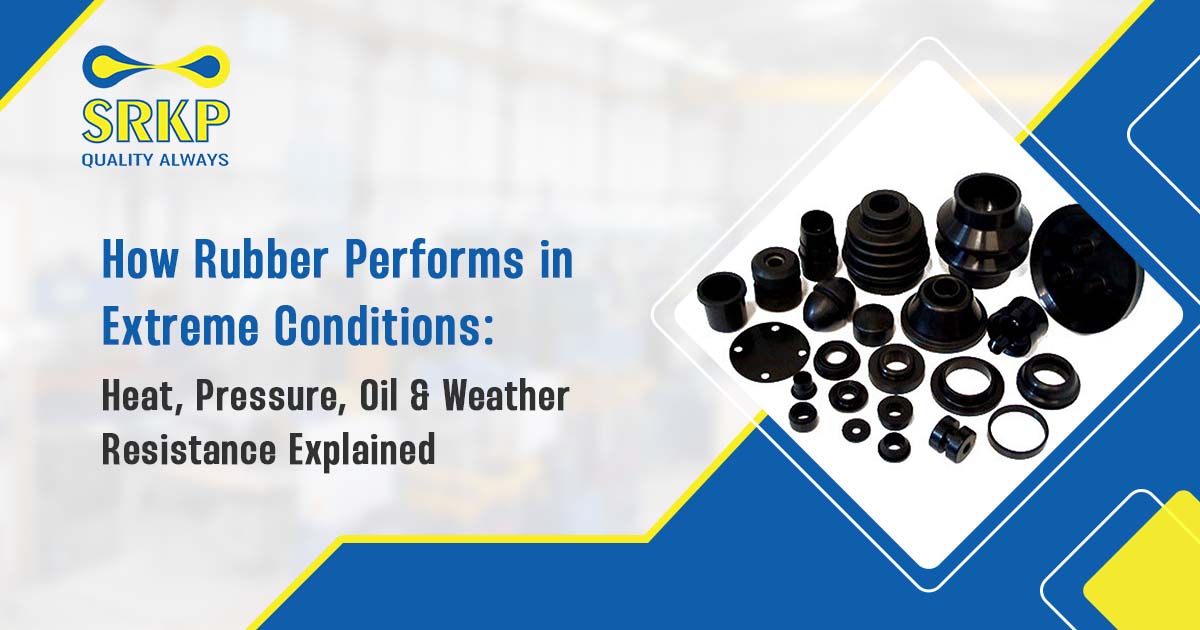
Rubber component failure in demanding industrial environments rarely comes as a surprise. It is almost always the result of a mismatch, between the elastomer chosen and the operating conditions it was never designed to handle. High compression set in a hydraulic seal, ozone cracking on an outdoor gasket, or catastrophic swelling in an oil-immersed diaphragm all trace back to the same root cause: the wrong compound in the wrong environment.
Understanding how different rubber materials respond to heat, pressure, oil, and weather exposure is what separates a well-specified component from a field failure. This article covers the material science and practical selection logic that engineering and procurement teams need when sourcing rubber for critical applications.
Rubber Performance Under Extreme Heat
Thermal degradation in rubber manifests as hardening, surface cracking, and permanent deformation, not as sudden failure. The compound continues to function at a reduced capacity until the accumulated damage crosses the threshold for seal loss or structural collapse. By that point, replacement is overdue.
Elastomer selection for heat resistance:
- Silicone (VMQ/PVMQ) — Continuous service up to 200°C; some specialty grades to 230°C. The Si-O backbone is inherently more stable than carbon-based polymers. Preferred for dry heat, electrical insulation, and food-contact applications. Limited mechanical strength, not suitable for dynamic, high-load environments without reinforcement.
- FKM (Fluorocarbon / Viton) — Rated to 200°C with simultaneous chemical and oil resistance. The preferred choice when heat and aggressive media coexist. Standard in aerospace, oil & gas, and turbocharger sealing.
- HNBR (Hydrogenated Nitrile) — Continuous rating to 150°C with strong mechanical properties and oil resistance. The dominant choice for automotive powertrain seals that face both heat and hydrocarbon exposure.
- EPDM — Rated to 130°C in air. Excellent for steam service and outdoor thermal cycling, but incompatible with petroleum oils.
- NBR — Ceiling of around 120°C. Adequate for moderate-temperature oil environments but not suitable for sustained elevated heat.
The critical specification is not the peak temperature but the continuous operating temperature combined with the media in contact. Silicone performs well in dry heat but degrades rapidly in petroleum oil. FKM handles both at a higher cost. Specifying based on peak excursion alone leads to over-engineering; ignoring it leads to premature failure.
SRKP’s compounding team works directly with clients to define the operating envelope and match it to the correct polymer and cure system including peroxide-cured compounds where low compression set at elevated temperatures is a priority.
Rubber Under Pressure: Compression Set and Extrusion
Rubber does not compress it deforms. Under sustained compression, the material redistributes its volume and generates the sealing force that holds a joint closed. The long-term question is whether it continues to do so after load is removed.
Compression set is the measure of permanent deformation after sustained compression, expressed as a percentage. A value of 0% means the rubber returns fully to its original height; 100% means it does not recover at all. For O-rings, face seals, and valve seats under sustained static load, compression set is the primary predictor of service life.
Factors that increase compression set:
- Elevated temperature (accelerates polymer chain relaxation)
- Sulfur-cured systems (generally higher set than peroxide-cured)
- Material hardness below what the application requires
For dynamic sealing applications reciprocating pistons, pump diaphragms, and rotating shaft seals a second concern is extrusion. Under high pressure, rubber forces itself into the clearance gap between mating metal surfaces. The result is nibbling, tearing, and seal destruction over time. The countermeasures are increased hardness (Shore A 75–90), tighter groove tolerances, or fabric reinforcement in diaphragm applications.
SRKP supplies fabric-reinforced diaphragms for high-pressure pump and valve applications combining elastomer flexibility with woven textile strength to eliminate extrusion failure under cyclic pressure loads.
Oil and Chemical Resistance: What the Elastomer Chemistry Determines
Rubber swelling in oil is not a defect it is a predictable consequence of molecular incompatibility. The degree of swell is governed by the polarity difference between the elastomer and the contact fluid. Non-polar hydrocarbon oils swell non-polar rubbers (NR, SBR, EPDM) aggressively. Polar elastomers resist them.
NBR is the industry benchmark for petroleum oil resistance. Its acrylonitrile (ACN) content directly controls the trade-off between oil resistance and low-temperature flexibility:
| ACN Content | Oil Resistance | Low-Temp Flexibility |
| 18–24% (Low) | Moderate | Excellent |
| 28–34% (Medium) | Good | Good |
| 38–50% (High) | Excellent | Limited |
Medium ACN grades (33–36%) dominate general-purpose oil sealing in hydraulic systems, pumps, and automotive components. High ACN grades are specified where oil exposure is severe and low-temperature performance is not a requirement.
HNBR is specified when NBR’s thermal ceiling is insufficient, turbocharger seals, power steering components, and oilfield equipment where both oil resistance and heat above 120°C are present simultaneously.
FKM handles the environments that no other elastomer can aromatic fuels, synthetic lubricants, phosphate ester hydraulic fluids, and concentrated acids. It is the default material for oil & gas sealing and aerospace fuel systems where volume swell beyond 10% in contact media is unacceptable.
EPDM, by contrast, excels in water, steam, dilute acids, and alkaline media but swells excessively in petroleum oils. Specifying EPDM in an oil environment is one of the most common and costly rubber selection errors in the field.
Weather, Ozone, and UV Resistance
Atmospheric degradation is slower than thermal or chemical attack, but it is equally certain for the wrong elastomer. Three mechanisms drive outdoor rubber failure:
Ozone cracking develops in elastomers with backbone unsaturation natural rubber, SBR, NBR when exposed to ambient ozone concentrations as low as 0.02 ppm. Cracks form perpendicular to tensile stress and propagate inward over time. In static applications, antiozonant waxes migrate to the surface and provide temporary protection; in dynamic applications, this protection is disrupted and the rubber must be inherently ozone-resistant.
UV degradation causes surface hardening, chalking, and chain scission in most polymer systems without protective additives. Carbon black is the most effective UV absorber in rubber, which is why black outdoor compounds outperform coloured or unpigmented grades in service life.
Thermal cycling from day/night and seasonal temperature swings causes repeated expansion and contraction. Over years, this fatigues the compound and opens micro-cracks that become ingress paths for moisture and ozone.
EPDM resolves all three issues. Its saturated polymer backbone is inherently ozone- and UV-resistant without relying on protective additives. Combined with carbon black reinforcement and antioxidant packages, well-formulated EPDM compounds deliver 20+ years of outdoor service in electrical infrastructure, HVAC systems, and architectural glazing seals. SRKP manufactures EPDM components for the power sector where long-term outdoor durability and electrical insulation properties are both mandatory.
For coloured or translucent outdoor compounds, Chloroprene (CR) and EPDM with silica reinforcement and UV stabiliser packages are the viable alternatives to carbon-black-loaded grades.
Elastomer Selection: Quick Reference
| Requirement | First Choice | Alternative |
| High heat (>150°C), dry | Silicone (VMQ) | FKM |
| High heat + oil/chemical | FKM | HNBR |
| Petroleum oil, moderate heat | NBR (medium ACN) | HNBR |
| Ozone + UV + weathering | EPDM | CR |
| Steam and hot water | EPDM | Silicone |
| Fuel / aromatic solvent | FKM | NBR (high ACN) |
| Dynamic pressure sealing | HNBR | FKM |
This table covers the majority of industrial sealing scenarios. Edge cases cryogenic service, nuclear radiation environments, food-contact requirements, or combined multi-media exposure require compound-level review with a qualified rubber technologist.
The Role of Compounding and Cure System
Elastomer selection defines the performance ceiling. Compound formulation determines whether a finished component reaches it. Two NBR seals with the same polymer backbone can have significantly different compression set, tensile strength, and heat resistance depending on:
- Cure system — Peroxide curing delivers lower compression set and better heat ageing than sulfur-based systems. Mandatory for components operating continuously above 120°C.
- Filler loading — Carbon black grade and loading affects hardness, tear resistance, and dynamic fatigue life.
- Plasticizer type — Determines low-temperature flexibility without sacrificing oil resistance.
- Antidegradant package — Antioxidants and antiozonants extend service life in thermally and atmospherically demanding environments.
At SRKP, every compound formulation developed in our R&D laboratory is validated against application-specific test parameters fluid immersion, compression set, tensile ageing, and accelerated weathering before approval for production. Our quality and certification framework ensures this validation is documented and traceable.
Frequently Asked Questions
Which rubber compound offers the best combination of heat and oil resistance? FKM (Fluorocarbon / Viton) is the industry answer. It maintains seal integrity in continuous service up to 200°C while resisting petroleum oils, synthetic lubricants, aromatic fuels, and hydraulic fluids. HNBR is the cost-effective alternative for applications where the temperature does not exceed 150°C.
What causes rubber seals to leak over time even without visible damage? The primary cause is compression set the elastomer has taken a permanent deformation and no longer generates sufficient sealing force against the mating surface. This is compound- and cure-system-dependent, not a processing defect. Switching to a peroxide-cured compound with a lower compression set rating resolves the issue in most static sealing applications.
Can SRKP develop a compound specifically for our operating conditions? Yes. Custom compound development is a core part of SRKP’s service offering. Our compounding chemists work from your operating temperature range, media exposure, pressure requirements, and dimensional constraints to formulate and validate a compound matched to your application from prototype through to approved production.
Conclusion
Rubber performance in extreme conditions is never accidental. It is the outcome of deliberate material selection, precise compound formulation, and rigorous validation every step aligned to the actual operating environment the component will face.
Heat, pressure, oil, and weathering each attack rubber through distinct mechanisms. No single elastomer handles all four equally well. The engineering discipline lies in identifying the dominant stresses in your application, selecting the appropriate polymer system, and ensuring the compound is formulated and cured to reach the performance ceiling that elastomer is capable of.
For industrial buyers, the risk of getting this wrong is not abstract it is unplanned downtime, seal replacements under load, and liability from field failures. For that reason, compound selection and component qualification deserve the same rigour as any other critical engineering decision in your system.


 PPTS
PPTS