
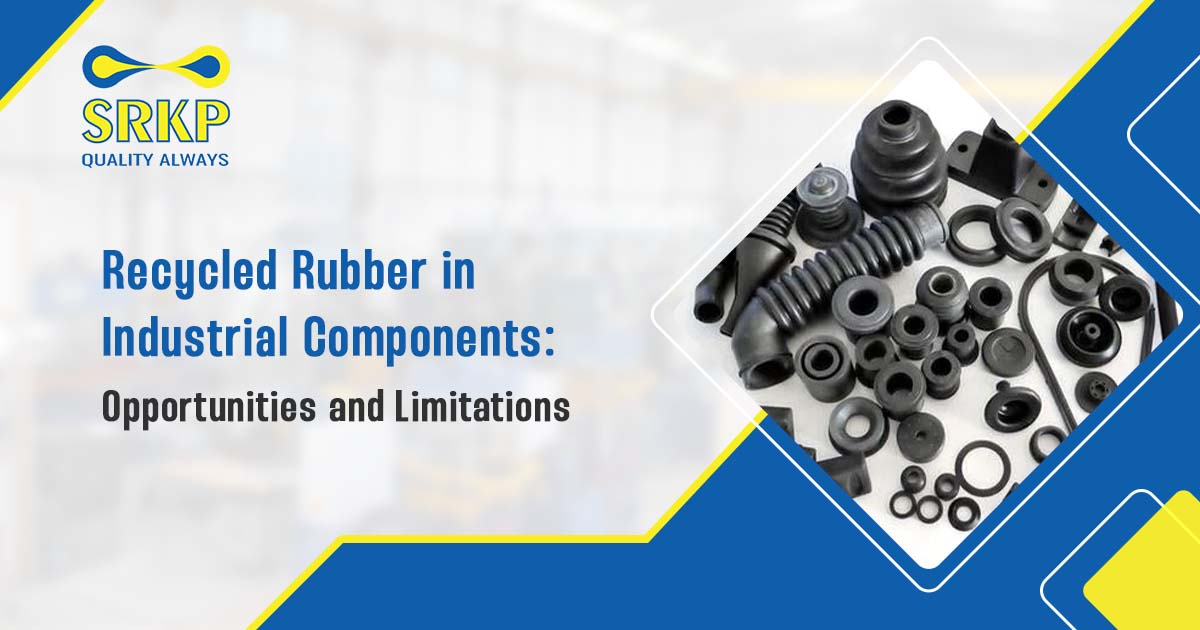
Sustainability is no longer a buzzword it is a business mandate. Across manufacturing sectors worldwide, procurement teams and design engineers are increasingly asking one critical question: Can we use recycled rubber in our industrial components without compromising performance?
It is a fair question, and the answer is nuanced. Recycled rubber, sourced from end-of-life tyres, industrial scrap, and post-production offcuts, offers genuine opportunities in specific industrial applications. But it also carries real limitations that, if ignored, can result in component failure, safety incidents, and costly downtime.
What Is Recycled Rubber? Understanding the Material Landscape
It is essential to understand what “recycled rubber” actually means in an industrial context. The term covers several distinct material categories with very different performance profiles:
- Ground Rubber / Crumb RubberProduced by mechanically shreddingvulcanised rubber (typically from scrap tyres) into fine particles. The vulcanisation crosslinks remain intact. This material is commonly used as a filler, in matting, and in non-load-bearing components.
- DevulcanisedRubber A more advanced process that uses heat, solvents, or microwaves to partially break the sulphur crosslinks, making the rubber reprocessable. Devulcanized rubber can be re-compounded and remoulded, though its mechanical properties are typically 15–40% lower than virgin compound.
- Reclaimed RubberProduced through thermomechanical or chemicalprocesses, reclaimed rubber retains some plasticity and can be blended with virgin rubber to reduce costs. It has been used in industrial applications for decades.
- Recycled Compound BlendsVirgin rubber compounds extended with recycled content at controlled ratios typically 10–30% recycled content to balance cost, performance, and sustainability.
Understanding which type of recycled rubber is being proposed for a component is the first step in any informed specification decision.
Opportunities: Where Recycled Rubber Delivers Real Value in Industrial Settings
Recycled rubber is not a second-rate material across the board. In the right applications and with the right formulation approach, it performs reliably and offers tangible business benefits.
Cost Reduction Without Performance Compromise in Non-Critical Components
For components that operate in low-stress, ambient-temperature, non-chemical environments, vibration isolation pads, anti-slip matting, cable management grommets, protective covers, and general-purpose gaskets, recycled rubber compounds can match the performance of virgin material at significantly lower raw material cost.
In high-volume production scenarios, blending 20–25% reclaimed rubber into a compound can reduce raw material costs by 15–25%, a meaningful saving at scale.
Vibration Damping and Noise Isolation Applications
Recycled rubber, particularly crumb rubber-based compounds, exhibits excellent vibration attenuation characteristics. This makes it well-suited for:
- Anti-vibration mounts in industrial machinery and HVAC equipment
- Acoustic insulation pads under compressors and generators
- Rail-track underlay and road-surface applications
- Floor mats and equipment bases in manufacturing facilities
The slightly lower elasticity of recycled material compared to virgin rubber is less critical in damping applications, where energy dissipation rather than elastic recovery is the primary requirement.
Sustainability Credentials and Supply Chain ESG Compliance
Many global OEMs and Tier 1 manufacturers now require suppliers to demonstrate measurable sustainability initiatives as part of procurement qualification. Incorporating verified recycled rubber content, with appropriate documentation, can support:
- ISO 14001 environmental management compliance
- ESG reporting requirements for listed companies
- Green procurement policies of automotive and aerospace customers
- Carbon footprint reduction documentation in supply chain audits
For manufacturers supplying to sustainability-conscious markets in Europe and North America, certified recycled rubber usage can be a genuine differentiator.
Secondary Sealing and Non-Contact Applications
In multi-seal assemblies where a secondary rubber element functions as a dust exclusion or light environmental seal (not a primary pressure seal), recycled rubber compounds can be cost-effective. Similarly, rubber bumpers, end stops, and protective pad applications in machine guards and tool storage are excellent candidates.
Prototyping and Development Tooling
During the early stages of component development particularly prototype tooling, jig pads, and fixture components, recycled rubber reduces development costs without affecting the validity of form-and-fit testing.
Limitations: Where Recycled Rubber Creates Unacceptable Risk
This is where technical honesty matters most. Many of the critical industrial rubber components manufactured today, seals, diaphragms, O-rings, aerospace grommets, hydraulic system components operate under conditions that expose the material’s vulnerabilities with precision.
High-Pressure Hydraulic and Pneumatic Sealing
Hydraulic and pneumatic seals must maintain dimensional stability and elastic recovery across thousands of pressure cycles. Recycled rubber compounds particularly those with devulcanisation-related crosslink damage exhibit:
- Reduced compression set resistance: The component deforms under load and does not fully recover, leading to seal leakage
- Inconsistent hardness distribution: Blended recycled compounds can have micro-hardness variation that creates preferential leak paths
- Lower tensile strength and tear resistance: Critical when seals experience extrusion forces in high-pressure applications
For hydraulic and pneumatic seals, valves, and diaphragms, SRKP exclusively formulates with virgin rubber compounds where dimensional precision and seal integrity are non-negotiable.
Chemical Resistance Applications — Oil, Gas, and Process Industries
The oil and gas industry demands rubber components that resist aggressive hydrocarbons, H₂S environments, steam, and concentrated acids. The chemical resistance of a rubber compound is precisely determined by its polymer backbone (NBR, FKM, HNBR, etc.) and the exact crosslink density achieved during vulcanisation.
Recycled rubber, especially multi-source ground rubber has an unknown and inconsistent chemistry profile. Contamination from incompatible polymers, degraded antioxidants, and compromised crosslinks can result in catastrophic chemical swelling or embrittlement in service.
Aerospace and Defence Component Applications
Aerospace rubber components such as O-rings, grommets, and environmental seals must meet stringent material specifications (MIL-spec, AS standards). These specifications define exact compound properties hardness, elongation, compression set, fluid resistance that must be repeatable batch to batch.
Recycled rubber cannot meet the traceability and batch consistency requirements that aerospace quality systems demand. The source material variability makes compliance with AS9100 and NADCAP requirements effectively impossible for recycled-content compounds.
High-Temperature and Thermal Cycling Environments
Elevated-temperature applications, power generation equipment, engine components, industrial ovens, require rubber compounds with specific thermal stability. Recycled rubber often contains degraded polymer chains and consumed antioxidants from its previous service life, meaning:
- Accelerated ageing and surface cracking at elevated temperatures
- Earlier onset of hardening and loss of flexibility
- Reduced resistance to thermal oxidation
For power industry components, including high-voltage insulating mounts, transformer components, and generator seals, thermal reliability is fundamental.
Food-Grade and Potable Water Applications
Components used in food processing, pharmaceutical manufacturing, or potable water systems such as SRKP’s NSF 61 certified valve wedges and diaphragms must be manufactured from compounds with verified, food-safe ingredients. The contamination risk from recycled rubber sources makes certification compliance impossible.
The Formulation Factor: How Blending Ratios Affect Performance
A key insight that separates informed engineers from those who simply reject or embrace recycled rubber wholesale is this: performance is a function of blend ratio and application-specific validation, not a blanket material classification.
Research and industry practice generally support these broad guidelines:
| Recycled Content | Typical Performance Impact | Suitable Application Range |
| 0–10% | Minimal impact on most mechanical properties | Broad including semi-critical components |
| 10–25% | Moderate reduction in tensile strength, elongation | Non-critical seals, anti-vibration, matting |
| 25–50% | Significant property reduction; close monitoring required | Bumpers, pads, non-sealing applications |
| >50% | Substantial degradation in mechanical and barrier properties | Construction fill, playground surfaces, road applications |
Any recycled content above 15% in a component that will experience cyclic loading, chemical exposure, or elevated temperature should be validated through a full suite of physical testing not assumed based on supplier data sheets alone.
What the Indian Manufacturing Sector Needs to Know
India’s rubber manufacturing sector is evolving rapidly, driven by regulatory pressure (the Plastic Waste Management Rules extension to rubber products is under active discussion), growing customer sustainability mandates, and the sheer volume of tyre-derived waste generated annually, estimated at over 1.1 million tonnes per year.
For Indian industrial rubber component manufacturers and buyers, the practical considerations are:
- Supply chain traceability of recycled rubber sources is still inconsistent in India; buyers must audit their suppliers’ sourcing documentation
- BIS and customer-specific approvals may not permit recycled rubber in critical applications without explicit validation and approval
- Export markets particularly the EU, with its growing Ecodesign for Sustainable Products Regulation (ESPR) are beginning to require documented recycled content, creating a push-pull dynamic that demands careful application classification
SRKP’s in-house rubber compounding facility and R&D team are actively developing formulation protocols for applications where recycled content can be responsibly incorporated while maintaining certification compliance.
How to Evaluate Whether Recycled Rubber Is Right for Your Application
Use this decision framework when reviewing component specifications:
Step 1 — Classify the function Is the component primary sealing, vibration control, structural bonding, or protective/non-contact? Primary sealing and structural applications generally exclude recycled rubber.
Step 2 — Review the operating environment Temperature range, fluid exposure, pressure, and cycle frequency all inform whether property degradation from recycled content is acceptable.
Step 3 — Check regulatory and customer specifications Does the component fall under aerospace, food-contact, potable water, or military specifications? If yes, virgin compound is almost certainly required.
Step 4 — Define the recycled content ceiling If proceeding with recycled content, define the maximum blend ratio and include it in the material specification not just the finished component drawing.
Step 5 — Validate through testing Conduct hardness, tensile, compression set, and application-specific fluid immersion testing on recycled-content compounds before release to production. Refer to ASTM D2000 and relevant customer-specific test standards.
Frequently Asked Questions (FAQs)
Q: Does recycled rubber cost significantly less than virgin rubber? Raw material savings from recycled content typically range from 15–30% depending on polymer type, blend ratio, and market conditions. However, additional compounding and quality validation costs partially offset material savings, particularly at lower volumes.
Q: How do we verify the recycled content of a rubber component? Analytical techniques including FTIR spectroscopy, thermogravimetric analysis (TGA), and pyrolysis GC-MS can characterize rubber compound composition. For supply chain verification, supplier documentation, third-party audits, and material certificates are the primary mechanisms.
Q: Are there rubber components used in automotive applications that use recycled rubber? Yes. Automotive anti-vibration components, mudguards, floor mats, grommets, and secondary seals have well-established use of recycled rubber blends, particularly in applications validated through OEM material approval processes.
Conclusion:
Recycled rubber in industrial components is neither a universal solution nor a universal compromise. It is a material strategy that demands application-specific intelligence the kind that comes from deep rubber technology expertise, rigorous testing infrastructure, and honest supplier dialogue.
The businesses that will navigate this territory most effectively are those who move beyond blanket policies (“we only use virgin rubber” or “we require 30% recycled content in all components”) toward application-by-application evaluation grounded in engineering data.


 PPTS
PPTS