
Industrial equipment doesn’t fail loudly. It fails quietly through a seal that slowly loses its bond, a damper that cracks over thousands of cycles, or a bushing that wears beyond recovery under load. By the time the failure is visible, the damage is already done.
At the centre of most of these failures is one component type that rarely gets the attention it deserves: bonded rubber components.
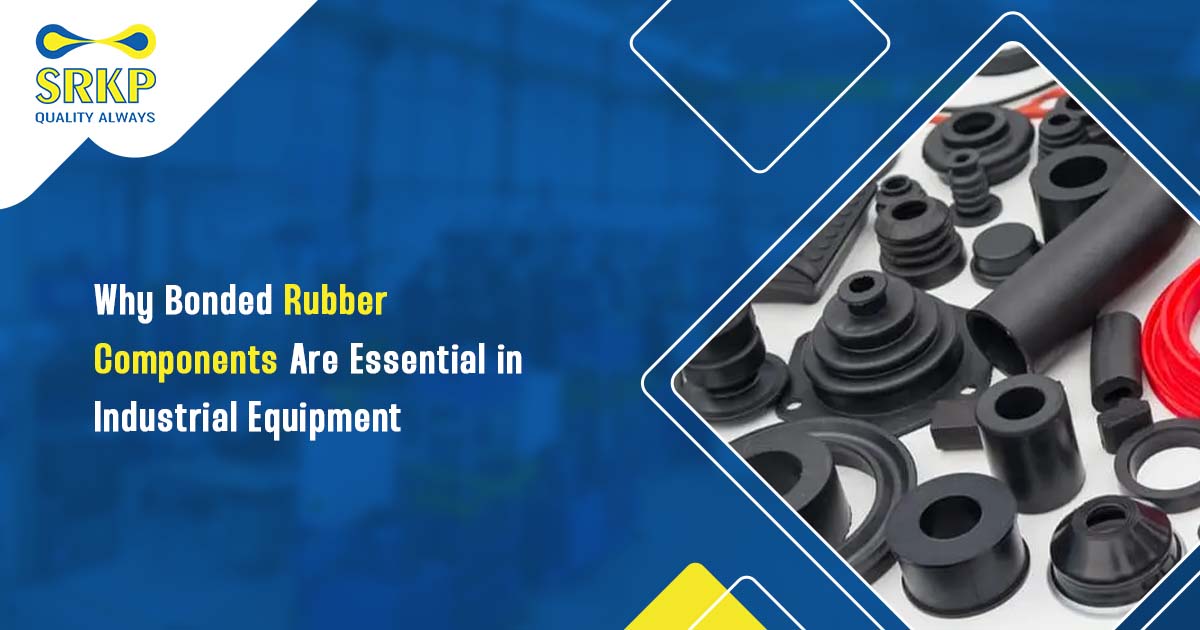
These are parts where rubber is permanently joined to a substrate such as metal, plastic, or PTFE through chemical adhesives and heat. As a result, they combine the flexibility of rubber with the strength of the substrate. Therefore, they are used across aerospace, automotive, oil and gas, defence, and many other industries.
In this guide, we explain what bonded rubber components are, why industries need them, how they are made, and what to look for in a manufacturer.
What Are Bonded Rubber Components?
Simply put, bonded rubber components are composite parts. Rubber is permanently joined to another material usually metal, plastic, or Teflon (PTFE) using chemical adhesives and heat vulcanization.
How Are They Different From Regular Rubber Parts?
Regular rubber parts, such as plain gaskets or O-rings, work on their own. Bonded rubber components, however, work together with a rigid substrate. This means they can:
- Absorb vibration and shock while keeping structural alignment
- Create leak-proof seals in high-pressure environments
- Handle extreme temperatures and chemical exposure
- Reduce the need for extra fasteners or clamps during assembly
Furthermore, the bond between rubber and metal is molecular. In other words, when done correctly, the rubber-to-metal joint is stronger than the rubber itself. Therefore, under load, failure happens in the rubber body not at the bond line. This is the gold standard in bonded rubber manufacturing.
Why Do Industrial Applications Need Bonded Rubber Components?
Industrial equipment runs in tough conditions. For example, hydraulic systems cycle thousands of times per hour. Pump housings face chemical exposure. Engine mounts absorb constant vibration. In all these cases, one material alone is not enough.
- Pure metal is too rigid. It transmits vibration and cracks under fatigue.
- Pure rubber lacks the strength to hold shape under heavy load.
- Bonded rubber components, however, solve both problems at once.
Key Benefits for Industrial Use
Vibration and Noise Isolation Bonded rubber mounts and dampers absorb vibration in rotating machines, engines, and compressors. As a result, they protect nearby components from fatigue failure and reduce noise in the process.
Dynamic Sealing Under Pressure Rubber bonded to metal creates seals that flex and recover under pressure. Therefore, they are ideal for hydraulic cylinders, valve assemblies, and pump chambers where pressure changes constantly.
Chemical and Heat Resistance Different rubber types resist different environments. For instance, NBR resists oil, EPDM resists steam and weather, and FKM (Viton) resists aggressive chemicals. As a result, bonded components can be matched precisely to the application.
Load Distribution Rubber-bonded bushings and bearings spread loads more evenly than metal-on-metal parts. Consequently, stress on the system is reduced and component life is extended.
Weight and Design Savings Additionally, replacing multi-piece metal assemblies with a single bonded rubber component reduces part count, assembly time, and overall weight especially important in automotive and aerospace design.
What Materials Are Used in Bonded Rubber Components?
The performance of a bonded rubber component depends on two things: the rubber compound and the substrate material. At SRKP, both are selected carefully based on the application.
Common Rubber Types
| Rubber Type | Key Properties | Typical Uses |
|---|---|---|
| NBR (Nitrile) | Oil and fuel resistant | Automotive seals, pumps, oil and gas |
| EPDM | Weather, ozone, and steam resistant | Power industry, outdoor sealing |
| FKM / Viton | Chemical and high-heat resistant | Oil and gas, aerospace, chemical plants |
| Silicone | Works from −60°C to +200°C | Aerospace, food-grade, medical |
| HNBR | Heat and chemical resistant with good strength | Automotive, defence, oil and gas |
| CR (Neoprene) | Weather, flame, and oil resistant | Marine, general industrial |
| Natural Rubber | Excellent stretch and tear resistance | Vibration dampers, heavy machinery |
| Polyurethane | High load capacity and abrasion resistant | Pumps, valves, wear parts |
Common Substrate Materials
- Mild steel and stainless steel — for strength and corrosion resistance
- Aluminium — for lightweight structural use
- Cast iron — for pump and valve housings
- Plastics (nylon, PP, ABS) — for lightweight bonded assemblies
- PTFE / Teflon — for non-stick applications with rubber flexibility
How Are Bonded Rubber Components Made?
The quality of a bonded rubber component depends almost entirely on the manufacturing process. A poorly prepared surface or wrong cure cycle will produce a part that looks fine but fails early in the field. Therefore, SRKP follows a strict step-by-step process.
Step 1 – Surface Preparation
First, the metal or plastic insert is shot-blasted, degreased, and chemically treated. This removes any oxide layer and creates the right surface texture. In fact, this is the most critical step a contaminated surface is the leading cause of bonding failure.
Step 2 – Adhesive Application
Next, bonding primers and covercoats are applied to the substrate. The adhesive type is chosen based on the rubber compound and the end-use environment of the part.
Step 3 – Rubber Compounding
At SRKP, rubber compounds are formulated in-house. This means the team can create specific compound recipes for each application rather than using off-the-shelf materials that may not be the best fit.
Step 4 – Moulding
Depending on the part’s shape, size, and tolerance requirements, SRKP uses one of three moulding methods:
- Compression moulding — best for high-volume, simpler parts
- Transfer injection moulding — better tolerance control for complex shapes
- Injection moulding — highest precision for small, detailed components
Step 5 – Vulcanization
After moulding, heat and pressure cause the rubber to cure and bond chemically to the adhesive-coated substrate. The result, therefore, is a permanent and integrated composite part.
Step 6 – Inspection and Testing
Finally, every component goes through flash removal, dimensional checks, hardness testing, and visual inspection. Additionally, destructive pull-off and peel tests confirm that bond strength meets the design requirement.
How Does SRKP Validate Bond Strength?
One of the most important questions to ask any rubber component supplier is: “How do you prove your bond strength?”
At SRKP, bonding validation is done through third-party certified testing. Components such as vibration dampers are tested under full-load conditions that simulate real-world use. Test data including load vs. elongation results confirms that the bond does not fail at the rubber-metal interface under design loads.
As a result, procurement teams can be confident that SRKP components will perform in the field exactly as tested in the lab.
Which Industries Use Bonded Rubber Components?
Bonded rubber components are used across nearly every heavy industry. Here is how SRKP serves key sectors.
Aerospace
Aerospace parts must work reliably from −60°C to +250°C and resist aviation fuels, hydraulic fluids, and de-icing chemicals. Therefore, SRKP manufactures aerospace rubber components including grommets, seals, and vibration isolators using Silicone, Fluorosilicone, and FKM compounds.
Automotive
Engine mounts, suspension bushings, oil seals, and transmission gaskets all contain bonded rubber components. As a result, SRKP’s automotive rubber parts serve two-wheeler and four-wheeler OEMs with NBR, EPDM, and silicone formulations.
Oil and Gas
High-pressure seals and valve seat inserts in oil and gas must resist H₂S, crude oil, and steam. Therefore, SRKP’s oil and gas rubber products use FKM, HNBR, and NBR compounds for these tough service conditions.
Defence
Defence applications need absolute reliability in extreme environments. Consequently, SRKP manufactures defence rubber components including O-rings, bellows, and seals that resist fuels, oils, and hydraulic fluids.
Power Generation
Vibration dampers, cable grommets, and transformer mounts for power equipment rely on EPDM and silicone-based power industry rubber components that hold up over decades of outdoor service.
Pumps and Valves
Pump diaphragms, rubber bushings, and valve seats are classic bonded rubber applications. Additionally, SRKP is NSF 61 certified for rubber valve components used in water and wastewater treatment.
Compression vs Transfer vs Injection Moulding – Which Is Best?
Many engineers ask which moulding process suits their application. The answer, however, depends on shape, volume, tolerance, and cost.
Compression Moulding
This is the most widely used process. Pre-formed rubber blanks are placed in a heated mould. It is cost-effective for medium-to-large parts with moderate tolerances. Furthermore, it works well for bonded components where inserts can be placed in the open mould.
Transfer Injection Moulding
This process offers better flash control and tighter tolerances. Therefore, it is preferred for complex bonded components where rubber must flow evenly around metal inserts.
Injection Moulding
This delivers the highest precision and consistency. As a result, it is used for small, high-complexity components at large production volumes. Additionally, it produces minimal flash and excellent dimensional accuracy.
SRKP operates all three processes. Therefore, the engineering team can recommend the right method for each new product development project.
How to Choose the Right Bonded Rubber Component Supplier
Choosing a bonded rubber supplier is a technical decision not a commodity purchase. Here are the key things to check:
- In-house compounding — suppliers who make their own compounds can optimise properties for your specific use case
- R&D and prototyping — reduces development risk and shortens time to market
- Testing infrastructure — in-house lab with tensile, hardness, and compression set testing
- Bond validation data — documented proof that bond strength meets design requirements
- Quality certifications — ISO 9001, NSF 61, and industry-specific approvals
- Industry experience — aerospace, oil and gas, and defence have very different qualification needs
- On-time delivery — essential for supply chain reliability
Conclusion
Bonded rubber components are not simple off-the-shelf parts. They are precision-engineered solutions where material science, process control, and application knowledge come together. Whether you need a vibration isolator for an aircraft, a diaphragm for a water valve, or a seal for an oilfield pump the long-term performance of that part depends on the expertise behind it.



 PPTS
PPTS