
Introduction
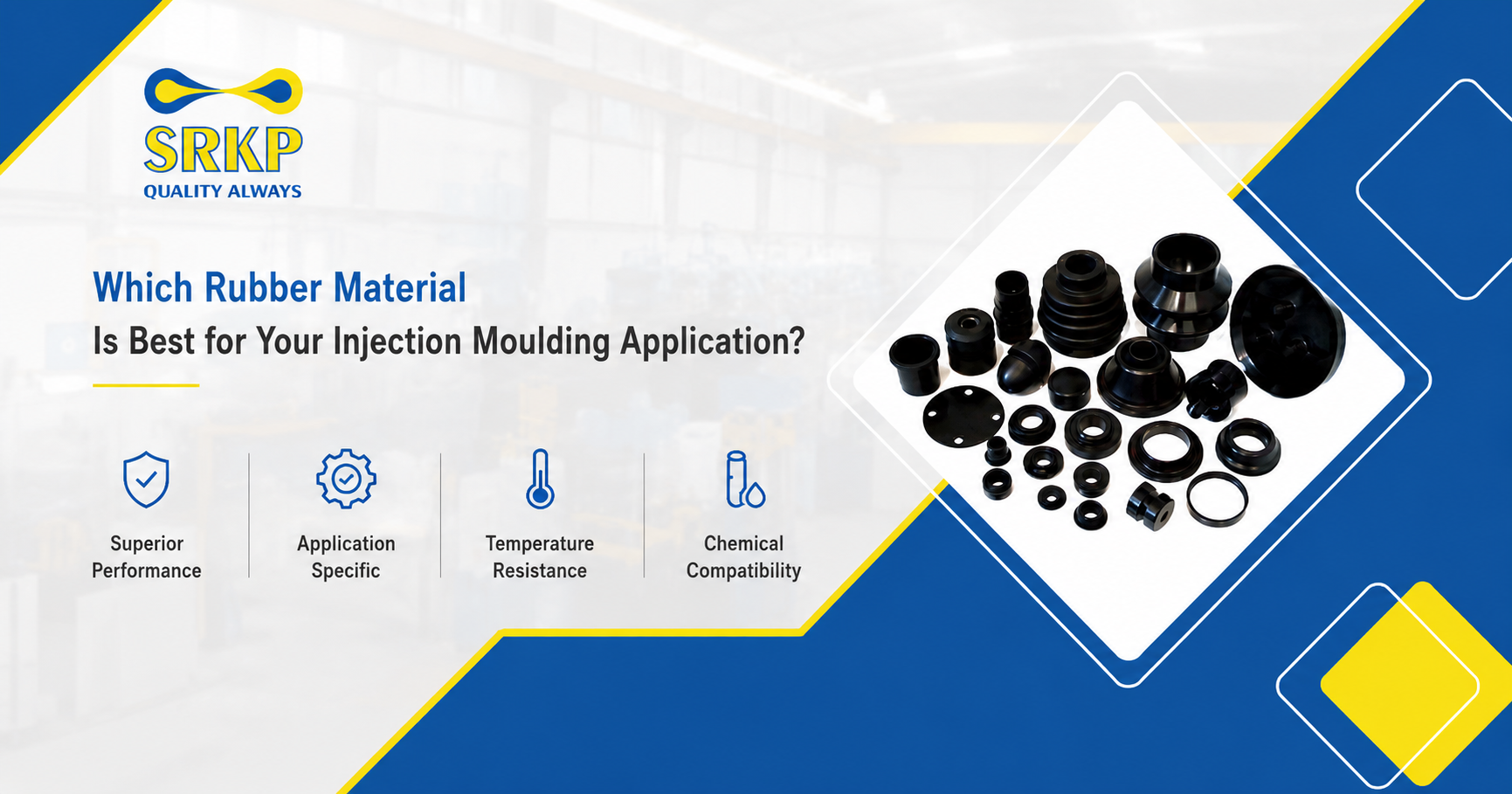
Choosing the wrong rubber compound is one of the most expensive mistakes a product team can make. A seal that swells in oil, a gasket that cracks under UV exposure, or a grommet that fails in the cold doesn’t just cause one bad part; it triggers warranty claims, line stoppages, and re-tooling costs that dwarf the original material’s decision.
This guide compares the rubber materials most used in injection moulding, NBR, EPDM, silicone, neoprene, FKM, HNBR, and TPE/TPV and shows you how to match each one to your application using temperature range, chemical resistance, and cost. You’ll also find a step-by-step selection process, common mistakes to avoid, and answers to the questions engineers and buyers ask most often.
What Is Rubber Material Selection?
Rubber material selection means matching an elastomer compound to the mechanical, thermal, and chemical demands of a part. Unlike plastic injection moulding, where one resin often works across many applications, rubber moulding success depends almost entirely on picking a polymer base whose chemistry survives the part’s working environment, because rubber parts are usually sealing, cushioning, or isolating against the very conditions that degrade elastomers fastest.
This decision carries extra weight because most rubber compounds are thermosets: once cured inside the mould, the cross-linked polymer can’t be reshaped or corrected. A wrong material choice can’t be fixed after the fact the way a plastic part sometimes can; the only remedy is re-moulding in a different compound. That’s why material selection made before a single mould is cut, is the highest-leverage decision in the whole project.
How the Process Works
Regardless of which elastomer is selected, rubber injection moulding follows a consistent sequence:
Planning – define the part’s operating environment (temperature, chemicals, UV/ozone exposure) and shortlist a candidate material.
Setup – the compound is loaded into the injection unit, as strip/pellet stock for solid rubber or as liquid components for LSR.
Configuration – the mould is heated to the compound’s curing temperature, with pressure and cycle time tuned to its flow characteristics.
Testing – sample parts are checked for hardness, flash, and dimensional accuracy before full production.
Deployment – the mould moves into production, with cured parts inspected and packaged.
Thermoplastic materials like TPE and TPV skip the curing step entirely, they melt and flow like standard plastics, which is why they run faster, cheaper cycles than thermoset rubbers such as NBR, EPDM, or silicone.
Why Getting This Right Matters
Longer Service Life
A compound matched to its environment resists degradation for years instead of months, cutting warranty and replacement costs.
Predictable Sealing Performance
The right compression set and chemical resistance keep seals tight under real operating pressure instead of leaking after the first thermal cycle.
Lower Total Cost of Ownership
A slightly higher-cost material that survives the application is almost always cheaper than a low-cost part that needs repeated replacement.
Regulatory Compliance
Medical and food-contact parts that use compliant silicone or FDA-grade NBR avoid costly redesigning down the line.
Rubber Material Comparison
The table below compares the seven material families most used in injection moulding.
| Material | Temp. Range | Oil/Fuel Resistance | Weather/Ozone | Relative Cost |
| NBR (Nitrile) | −30°C to 120°C | Excellent | Poor | Low |
| EPDM | −40°C to 150°C | Poor | Excellent | Low–Medium |
| Silicone (VMQ) | −60°C to 200°C+ | Fair | Excellent | High |
| Neoprene (CR) | −30°C to 100°C | Moderate | Good | Medium |
| FKM (Viton) | −20°C to 200°C+ | Excellent | Excellent | Very High |
| HNBR | −25°C to 150°C | Excellent | Good | High |
| TPE / TPV | −40°C to 120°C | Fair–Good | Good | Low–Medium |
Rubber Material Selection by Industry
Automotive
NBR and HNBR dominate fuel and oil seals; EPDM is standard for window and door weatherstripping; silicone and FKM handle engine-bay components exposed to extreme heat alongside oils and coolants.
Medical Devices
Medical-grade silicone is the default for valves, seals, and wearable components, thanks to its biocompatibility and stability across a wide temperature range.
Industrial & HVAC
NBR and HNBR seal hydraulic systems; EPDM is the standard for steam, water-handling equipment, and roofing membranes where oil exposure isn’t a concern.
Consumer Electronics
TPE and silicone are favoured for soft-touch grips, waterproof buttons, and protective cases, balancing comfort, durability, and moulding speed.
Is This Material Right for Your Application?
| Application | Recommended Material | Why |
| Automotive fuel/oil seal | NBR or HNBR | Best-in-class oil and fuel resistance. |
| Outdoor weatherstripping/roofing | EPDM | Excellent ozone, UV, and weather resistance. |
| Medical device component | Silicone (medical-grade) | Biocompatible and sterilizable. |
| Hot oil / high-heat industrial seal | FKM | Survives high heat plus chemical exposure. |
| Consumer electronics soft-touch part | TPE | Fast cycles, comfortable feel, cost-effective. |
| General-purpose wetsuit/hose/belt | Neoprene (CR) | Balanced oil, weather, and flex performance. |
| Food-contact gasket/tubing | Food-grade silicone or EPDM | Chemical inertness, regulatory compliance. |
How Much Does It Cost?
Relative Cost Ranges
- NBR and EPDM – lowest cost per kilogram, best for high-volume, cost-sensitive parts.
- Neoprene and TPE/TPV – moderate cost, a balance of performance and processability.
- HNBR – a step up from NBR, justified when oil resistance must be paired with higher heat tolerance.
- Silicone and FKM – premium materials, reserved for medical, food-grade, or extreme-condition parts.
Hidden Costs to Watch For
- Re-tooling after a material failure discovered in field testing.
- Scrap rate from compounds that aren’t actually optimized for injection (versus compression) moulding.
- Compliance testing for medical, food-contact, or automotive-spec parts.
The ROI case is simple: a part made from the correct, slightly pricier compound that lasts the product’s full service life is almost always cheaper than a low-cost part replaced two or three times over the same period.
Common Mistakes to Avoid
- Choosing on cost alone, picking NBR for an outdoor seal because it’s cheap, then watching it crack within a season from UV exposure.
- Ignoring real operating temperature, specifying a compound rated to 120°C for a part that sits near an exhaust manifold.
- Overlooking chemical exposure, using EPDM where it will contact petroleum-based oils, a combination it cannot survive.
- Treating compression-grade compounds as injection-ready some formulations flow well in compression moulding but scorch or under-fill in injection tooling.
- Skipping compression-set testing a seal can look fine on day one and still leak within months if it doesn’t spring back under sustained load.
Best Practices
✓ Map the full operating environment chemicals, temperature, UV before shortlisting materials.
✓ Request the manufacturer’s datasheet for the exact compound grade, not just the generic polymer family.
✓ Confirm the compound is proven for injection moulding, not only compression moulding.
✓ Test compression set under realistic load and temperature, not just at room temperature.
✓ Build in a prototype-and-test phase before committing to production tooling.
Real-World Example
An equipment manufacturer was using a low-cost NBR gasket on an outdoor enclosure. Within eight months, gaskets in sun-exposed installations were cracking and losing their seal, leading to water ingress and a wave of warranty claims. The root cause was clear: NBR has poor ozone and UV resistance, and the parts were operating in direct sunlight, the one environment that material can’t tolerate long-term.
The team switched the gasket to EPDM, a compound formulated specifically for ozone and UV resistance, keeping the same mould geometry and adjusting cure parameters for the new compound. Field failures dropped sharply in the following service cycle, and warranty claims tied to gasket cracking were effectively eliminated. The per-part material cost rose modestly, but total cost of ownership, including warranty replacements and service visits, fell well below the original baseline.
Frequently Asked Questions
These are the questions engineers, procurement teams, and product designers ask most often.
What is the most durable rubber for injection moulding?
It depends on the failure mode. NBR and HNBR last longest against oil and fuel; EPDM is most durable outdoors against UV and ozone; FKM wins when heat and chemicals combine.
Which rubber material is cheapest?
NBR and EPDM are generally the least expensive per kilogram, making them the default for high-volume, cost-sensitive parts. Silicone and FKM are the premium end.
Can silicone and EPDM be used interchangeably?
Not reliably. Silicone tolerates a wider temperature range and is biocompatible, making it better (and pricier) for medical and food-contact parts. EPDM is the more cost-effective choice for general outdoor sealing.
Why does NBR fail outdoors?
NBR has poor resistance to ozone and UV. Extended sun exposure breaks down its structure, causing cracking exactly the failure mode EPDM is built to resist.
What’s the difference between rubber and silicone injection moulding?
Solid rubber compounds (NBR, EPDM, neoprene) are processed as strip or pellet stock. Silicone moulding typically uses liquid silicone rubber (LSR), a two-part liquid metered before injection, requiring different tooling.
Is TPE the same as rubber?
TPE behaves like rubber but processes like plastic. Unlike thermoset rubbers, it melts and re-solidifies without curing, so it can be reground, reused, and moulded in shorter cycles.
What rubber is best for medical devices?
Medical-grade silicone is the standard, due to its biocompatibility, sterilizability, and stability across a wide temperature range.
Which rubber resists both oil and high heat?
FKM (often sold as Viton) and HNBR are the leading choices when a part must resist hot oils, fuels, and chemicals at elevated temperatures simultaneously.
How do I know if a compound is injection-mould compatible?
Compatibility isn’t determined by the polymer name alone it depends on the specific compound’s flow behaviour and cure balance under injection conditions. Always confirm with your supplier or moulder that the exact grade is validated for injection moulding, not just compression moulding.
Conclusion
There’s no universal “best” rubber for injection moulding, only the best match for your part’s operating environment. NBR and HNBR lead on oil resistance, EPDM dominates outdoor exposure, silicone is unmatched for medical and extreme temperatures, and TPE/TPV offer speed and recyclability for high-volume parts.
Let your application’s harshest real-world condition not cost alone drive the material decision, and confirm with your moulder that the specific compound grade is proven for injection moulding before committing to tooling.

 PPTS
PPTS