
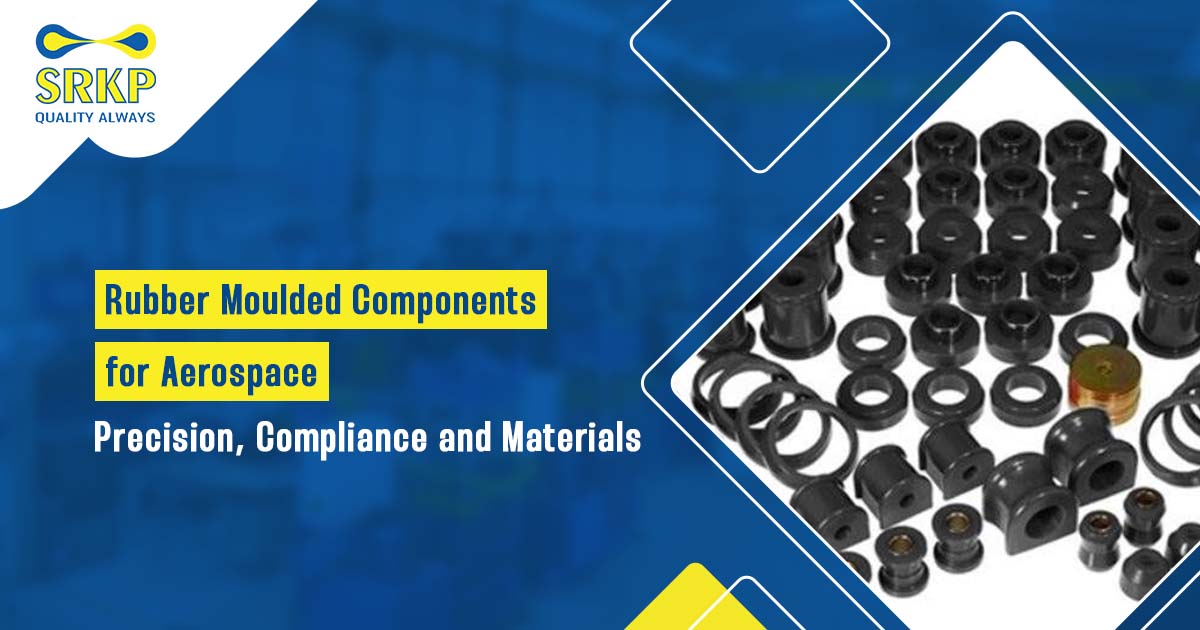
Aerospace Rubber Moulded Components: Materials, Processes, and Compliance
In aerospace, a component either performs perfectly or it fails completely. There is no middle ground. A rubber seal inside a fuel system at 40,000 feet must hold. A bonded vibration isolator protecting an avionics package from engine vibration must not crack, creep, or degrade.
That reality shapes every decision in aerospace rubber molding. Material selection, process choice, tolerance specification, and compliance documentation all carry consequences that simply do not exist in general industrial manufacturing.
This guide breaks down what it takes to engineer, manufacture, and qualify aerospace rubber moulded components. We cover the rubber compounds that matter, the molding processes that deliver precision, and the compliance frameworks that govern the supply chain.
Why Aerospace Sets a Higher Bar for Rubber Moulded Products
Standard industrial rubber moulded products perform within defined service conditions at acceptable reject rates. Aerospace rubber moulded components, however, must perform outside normal conditions at temperature extremes, under chemical attack from aggressive aviation fluids, and under cyclic mechanical stress with a defect rate approaching zero across the entire production run.
Several key differences separate aerospace-grade rubber molding from general industrial production:
- Tighter dimensional tolerances — typically ±0.1 mm or better on critical sealing surfaces for precision seals and O-rings
- Full material traceability — every rubber compound batch must link to raw material lot, mixing record, and test certificate
- Qualification testing per AMS / AS standards — not just functional testing, but formal qualification against published aerospace material specifications
- First Article Inspection Reports (FAIR) — most aerospace programmes require these before production release
- Certified quality management systems — AS9100 Rev D as a minimum; some OEMs add customer-specific requirements on top
This level of rigor starts at compound development and runs through every production stage. Cutting a corner anywhere using an unvalidated substitute compound, skipping a hardness test, or relaxing flash removal standards creates a non-conformance that can cascade through an entire aircraft programme.
Selecting the Right Rubber Compound for Aerospace Applications
The rubber compound forms the foundation of every aerospace rubber moulded component. If the compound is wrong, the part will fail in service regardless of how precisely the manufacturer moulded it. Therefore, engineers must match the compound to three primary factors: the fluid environment, the operating temperature range, and the mechanical loading.
Fluorocarbon (FKM / Viton®) — The Fuel System Standard
FKM is the dominant rubber compound for aerospace fuel system precision seals, O-rings, and gaskets. Its outstanding resistance to Jet-A, Avtur, and Skydrol hydraulic fluid combined with continuous service capability from −20°C to +200°C makes it the first-choice material for most fuel and hydraulic sealing applications. Where engineers need even higher chemical resistance, specialty FKM grades (GF, GFLT) extend the performance envelope further.
Fluoro Silicone (FVMQ) — When Temperature Range and Fuel Resistance Both Matter
Standard silicone rubber handles extreme temperature ranges (−60°C to +230°C) but offers poor fuel resistance. Fluoro silicone closes that gap by combining silicone’s broad thermal flexibility with meaningful resistance to aviation fuels. As a result, engineers commonly specify it for connector grommets, environmental seals, and fuel-adjacent applications where temperature cycling drives the design requirement.
Silicone (VMQ / PVMQ) — Thermal Flexibility for Cabin and Electrical Applications
Pure silicone remains the material of choice for cabin seals, electrical harness grommets, and any application where low-temperature flexibility and electrical insulation matter more than fuel resistance. Consequently, silicone rubber moulded products appear most often in airframe sealing, avionics compartments, and environmental protection roles rather than in direct contact with fuels.
EPDM — Environmental and Phosphate Ester Fluid Resistance
EPDM offers strong ozone, weather, and phosphate ester hydraulic fluid resistance. Manufacturers use it widely in connector applications SRKP’s aerospace UTS connectors, for example, are produced in EPDM as well as in environmental seals and grommets across airframe assemblies. Notably, EPDM is not suitable for petroleum-based fuel contact, which defines clearly where this material is and is not appropriate.
Neoprene (CR) Balanced Performance for Connector and Sleeve Applications
Chloroprene (Neoprene) delivers a practical combination of oil resistance, weather resistance, and mechanical durability. In aerospace connector systems, engineers specify Neoprene extensively for sleeves and press packing sealed cable transit components. It is not a high-temperature compound, but for connector protection and moderate fluid resistance applications, it provides cost-effective performance within its service limits.
HNBR — Elevated-Temperature Oil and Fuel Resistance
Hydrogenated Nitrile (HNBR) is the high-temperature upgrade from standard NBR. It maintains strong resistance to petroleum-based fuels and oils while extending the continuous service temperature ceiling to approximately +150°C. This makes it viable for engine-adjacent and under-cowl applications where standard NBR would degrade under thermal aging.
Rubber Molding Processes: Matching the Method to the Application
Precision rubber parts for aerospace come from one of three primary molding processes. The choice of process is not arbitrary. Instead, it depends on component geometry, required tolerance, production volume, and the nature of the rubber compound.
Compression Moulding
In compression moulding, the operator places rubber compound directly into an open mould cavity. The mould then closes under hydraulic pressure, and heat vulcanizes the compound to its final shape. Compression moulding is the most established rubber molding process, and it remains highly relevant for aerospace particularly for larger components, fabric-reinforced diaphragms, bonded metal-rubber assemblies, and lower-to-medium volume precision parts where injection tooling investment is not justified.
The critical variable in aerospace compression moulding is precise charge weight control. Overfilling wastes material and creates excessive flash. Underfilling, on the other hand, creates knit lines and incomplete fill both non-conformances in an aerospace quality context.
Injection Rubber Molding
Injection rubber molding heats the compound to a plasticized state and injects it under high pressure into a fully closed mould. For aerospace rubber moulded components, the advantages are significant: shorter cure cycles, better dimensional consistency across a multi-cavity tool, reduced flash, and suitability for complex geometries that compression cannot fill consistently.
For precision seals, O-rings, and connector components where dimensional tolerances are tightest, injection rubber molding is typically the process of choice. Furthermore, it offers better process repeatability, which directly supports the batch-to-batch consistency requirements of aerospace quality systems.
Transfer Injection Moulding
Transfer moulding sits between compression and full injection in both capability and tooling investment. Pre-plasticized rubber transfers from a central pot through sprues into multiple mould cavities simultaneously. Dimensional uniformity is better than compression moulding, while tooling costs are lower than full injection. As a result, this process suits moderate-complexity components at mid-range volumes well.
SRKP uses transfer injection moulding where it delivers the best balance of dimensional performance and production economics for a given aerospace component recognising that specifying the optimal process is as important as specifying the optimal compound.
Compliance Frameworks That Govern Aerospace Rubber Moulded Components
Compliance in aerospace rubber molding is not a tick-box exercise. Instead, it is the framework that gives OEMs and certification authorities confidence that components will perform as specified across an aircraft’s entire service life.
AS9100 Rev D — The Quality Management Baseline
AS9100 is the quality management standard for aviation, space, and defence manufacturing. It builds on ISO 9001 with aerospace-specific requirements including risk management, configuration management, first article inspection, and on-time delivery monitoring. In practical terms, any supplier of rubber moulded components to a Tier 1 aerospace manufacturer without AS9100 certification is unqualifiable for most programmes.
AMS Specifications — Material Qualification Standards
SAE’s Aerospace Material Specifications define the property requirements for rubber compounds in aerospace components. Commonly referenced AMS specs for rubber moulded components include:
- AMS 7276 — Fluorosilicone O-ring materials
- AMS 7259 — Fluorocarbon (FKM) elastomer compounds
- AMS 7257 — Silicone rubber for general aerospace use
- AMS 3209 — EPDM compounds for specific aerospace applications
A qualified aerospace rubber manufacturer must either compound to these specifications in-house or source verified material with test certification. Additionally, the manufacturer must provide evidence of compound compliance as part of the batch documentation package.
REACH Compliance
For components destined for European aerospace OEMs or aircraft operating in EU-regulated airspace, REACH compliance has moved from desirable to a standard requirement. This demands full visibility into the chemical composition of every rubber compound something that is only practically achievable when compounding happens in-house with documented formulations and verified raw material supplier declarations.
Precision and Tolerancing in Aerospace Rubber Moulded Components
The phrase “precision rubber parts” carries a specific technical meaning in aerospace that goes beyond visual appearance or general dimensional accuracy.
For precision seals in hydraulic and fuel systems, engineers and inspectors routinely specify and check the following tolerance parameters:
| Parameter | Typical Requirement |
|---|---|
| Cross-sectional diameter (O-rings) | Per AS568 or BS1806; Class 1 tolerances as tight as ±0.08 mm on smaller sizes |
| Hardness | ±5 Shore A or IRHD from nominal compound specification |
| Compression set | Maximum values defined by applicable AMS standard after 70-hour or 168-hour aging |
| Volume change in fluid | Percentage swell limits in reference aviation fuel or hydraulic fluid per AMS method |
| Surface finish | Freedom from porosity, blisters, and inclusions — verified visually and dimensionally |
Achieving these tolerances consistently requires more than accurate tooling. It also demands controlled compound mixing, validated cure parameters, and a measurement system capable of detecting out-of-tolerance parts before they leave the facility.
Testing and Quality Assurance for Aerospace Rubber Moulded Products
Every batch of aerospace rubber moulded components should carry documented test data. The testing regime typically covers:
| Test | Purpose | Standard Reference |
|---|---|---|
| Tensile strength & elongation | Confirms compound integrity | ASTM D412 / ISO 37 |
| Hardness (Shore A / IRHD) | Verifies compound batch consistency | ASTM D2240 / ISO 48 |
| Compression set | Predicts long-term sealing performance | ASTM D395 / ISO 815 |
| Volume swell in fluid | Validates chemical resistance | ASTM D471 |
| Low-temperature flexibility | Confirms cold-weather sealing capability | ASTM D2137 |
| Dimensional inspection | Verifies part geometry to drawing | Per customer drawing / AS568 |
| Visual inspection | Detects surface defects | Per AMS 2631 or equivalent |
For new part numbers or design changes, a First Article Inspection Report (FAIR) per AS9102 is typically required before production parts are accepted. The FAIR documents dimensional results for all drawing characteristics, material test results, and process certification evidence in a single controlled package.
Common Design Challenges in Aerospace Rubber Moulded Components
Engineering teams working on aerospace sealing and vibration isolation frequently encounter challenges that require deep material and process expertise to resolve.
Fluid compatibility conflicts arise when an application contacts two fluids for example, a petroleum-based lubricant and a phosphate ester hydraulic fluid that pull in opposite compound directions. Engineers must either select a compound with acceptable resistance to both fluids, or redesign to isolate the seal from one of them.
Temperature cycling deformation affects precision seals that cycle repeatedly between −55°C and +150°C. Over time, these seals can suffer permanent compression set, reducing sealing force and ultimately causing leaks. Compound selection (lower compression set materials such as HNBR or FKM with an appropriate cure system) and seal groove geometry optimisation both address this issue.
Flash management on complex geometries is a significant concern in multi-cavity injection tooling. Complex aerospace rubber parts require precise parting line design and tight tool manufacturing tolerances to prevent flash in critical sealing areas. Flash on the sealing lip of an O-ring groove, for example, creates a direct leak path.
Bonded component bond line failure can occur in metal-to-rubber bonded aerospace components when failure happens at the bond interface rather than in the rubber body. Inadequate surface preparation, poor primer application, or insufficient moulding pressure can all cause this. Therefore, validated bonding processes with documented bond shear strength data are essential for this component type.
Frequently Asked Questions
What rubber compound suits hydraulic system seals in aerospace?
FKM (Fluorocarbon / Viton) is the standard for Skydrol-based hydraulic system precision seals due to its excellent phosphate ester resistance. For mineral oil-based hydraulic fluid, engineers typically specify HNBR or NBR. In either case, the specific compound grade should match the applicable AMS specification for the fluid type.
What is the difference between injection rubber molding and compression moulding for aerospace parts?
Injection rubber molding injects pre-heated compound into a closed mould under high pressure, producing better dimensional consistency, shorter cycle times, and less flash. Compression moulding places compound in an open cavity and closes it under pressure, which suits larger, simpler geometries and lower volumes better. Ultimately, the optimal process depends on the component’s geometry and production volume.
What is compression set and why does it matter for precision seals?
Compression set measures how much a rubber seal fails to recover its original dimensions after compression at elevated temperature for a defined period. A high compression set means the seal permanently deforms, reducing contact force and therefore sealing performance. For aerospace precision seals, low compression set typically below 20–25% is a fundamental performance requirement.
What is a press packing in aerospace rubber components?
A press packing is a sealed cable transit component a rubber moulded sleeve that seals a cable or wire bundle as it passes through a bulkhead or connector body. It provides both mechanical protection and environmental sealing, preventing fuel, moisture, or contaminant ingress along the cable path. Neoprene and EPDM are the typical materials.
Checklist: Qualifying an Aerospace Rubber Moulded Components Supplier
Before approving a rubber molding supplier for an aerospace programme, procurement and quality teams should verify the following:
- AS9100 Rev D certification current, with scope covering relevant product types
- Documented rubber compound capability in-house mixing or verified AMS-compliant supply chain
- Multi-process moulding capability injection rubber molding, compression, and transfer moulding
- In-house testing laboratory with ASTM/ISO testing capability
- FAIR capability per AS9102
- Material traceability system from raw rubber to finished part
- REACH and RoHS compliance documentation process
- Tooling design and manufacture capability (in-house preferred)
- Track record of aerospace supply references, programme history, export capability
Conclusion
Aerospace rubber moulded components leave no room for compromise. The right rubber compound, the right molding process, and a fully documented compliance trail are not optional extras they are the baseline.
Whether you source precision seals for a fuel system, connector grommets for avionics, or bonded vibration isolators for an engine mount, every material and process decision directly determines in-service reliability. Suppliers who combine in-house rubber compound expertise, injection rubber molding capability, and AS9100-certified quality systems are the ones aerospace programmes can depend on not just for the first delivery, but across the full production lifecycle.


 PPTS
PPTS