
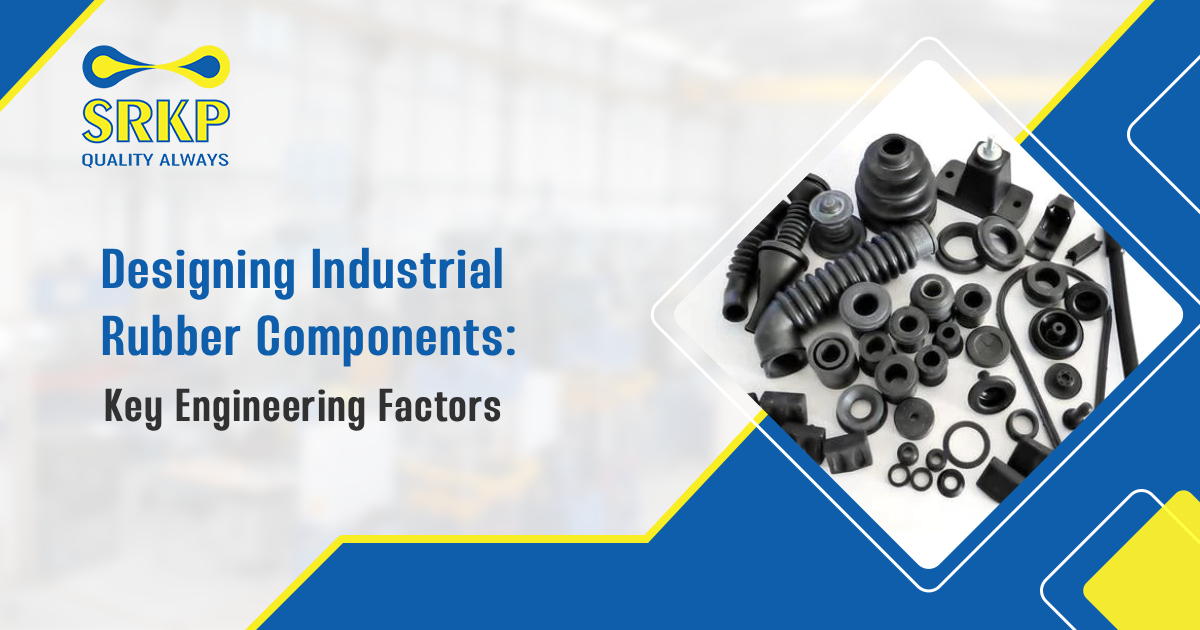
In industrial operations, a single component failure can halt an entire production line. Industry estimates place the average cost of unplanned downtime at $260,000/hr, making component reliability a direct bottom-line issue, not just a technical one.
For procurement managers, plant engineers, and technical buyers, sourcing the right rubber component goes beyond price comparison. Material compounds, molding methods, tolerance specifications, and validation process each determine whether a part performs for months or years. At Sri Ramkarthic Polymers Pvt Ltd, we work with OEMs and industrial clients across automotive, fluid handling, heavy engineering, and infrastructure sectors. This guide draws from that hands-on experience to help your teams ask the right questions before finalizing a rubber component order.
Selecting the Right Rubber Compound
Material selection is where performance is won or lost. The wrong compound in the wrong environment causes premature swelling, cracking, or seal failure. Here is a working reference for the most common industrial compounds:
Compound | Key Strengths | Operating Range | Typical Applications |
NBR | Petroleum oils, fuels, hydraulic fluids | –40°C to +120°C | Automotive seals, O-rings, fuel gaskets |
EPDM | Weathering, ozone, UV, steam | –50°C to +150°C | HVAC seals, outdoor enclosures |
Silicone (VMQ) | Extreme temperatures, food/pharma contact | –60°C to +230°C | Medical devices, food processing |
Neoprene (CR) | Chemical, flame, and mechanical resistance | –40°C to +120°C | Marine gaskets, conveyor belts |
FKM / Viton | Aggressive chemicals, high heat | –20°C to +200°C | Chemical processing, oilfield seals |
HNBR | Oil + high temperature combined | –40°C to +150°C | Automotive timing belts, oilfield equipment |
Procurement Note: Many component failures we investigate trace back to compound substitution made for cost reasons, typically replacing FKM with NBR in a high-chemical-exposure environment. The short-term savings are erased within one replacement cycle. Learn more about ours rubber compounds and material capabilities.
Aligning Design with Real Operating Conditions
Industrial rubber parts operate under combined stresses, not lab conditions. Before finalizing specifications, document and share the following with your manufacturer:
Mechanical loads: Is the part statically loaded or dynamically cycled? At what frequency and amplitude?
Temperature profile: Continuous operating temperature, peak spikes, and cold-start conditions. Standard NBR hardens significantly below –20°C; silicone maintains flexibility down to –60°C.
Chemical exposure: Not just the primary fluid, but cleaning agents, lubricants, and incidental substances. Cross-reference with ASTM compound resistance data.
Pressure requirements: High-pressure sealing above 100 bar demands tighter dimensional control and may require PTFE back-up rings to prevent extrusion.
Sharing a completed service condition data sheet at the RFQ stage, rather than after samples are in production, reduces revision cycles and accelerates qualification timelines significantly.
Matching the Molding Process to the Part
Three primary molding methods are used in industrial rubber manufacturing:
Compression Molding suits large, simple geometry parts and high-hardness compounds. Typical tolerances: ±0.2–0.5 mm. Cost-effective for medium to large runs.
Transfer Molding delivers better dimensional consistency (±0.1–0.3 mm) and handles insert-molded parts with metal or plastic components well.
Injection Molding provides the highest repeatability (tolerances approaching ±0.05 mm) for complex geometries and high-volume production above 50,000 units per annum, with shorter cycle times and minimal flash.
At SRKP, we operate all three molding lines, explore our moulding infrastructure, allowing us to recommend the most technically and commercially appropriate process for each application rather than defaulting to what is most convenient.
Design for Manufacturability (DFM)
Poor part design is one of the most common causes of quality escapes in rubber supply chains. Applying DFM principles at the design stage reduces scrap, shortens cure times, and improves batch-to-batch consistency.
- Uniform wall thickness prevents uneven curing and internal stress concentrations
- Draft angles of 3–5° on vertical walls reduce mold wear and improve surface quality
- Internal corner radii of minimum 0.5–1.0 mm extend fatigue life in dynamic applications
- Parting line placement must be specified explicitly, flash at a sealing surface is far more damaging than flash on a non-functional face
Tolerance calling also matters rubber is viscoelastic and specifying tighter than ±0.1 mm without engineering justification adds cost without improving function. We conduct DFM reviews with client engineering teams before tool cutting, a step that consistently reduces first-article rejection rates.
Quality Testing & Validation
Industrial rubber components must meet documented performance standards. Key tests include:
- Tensile Strength & Elongation (ASTM D412): Industrial-grade NBR targets ≥10 MPa tensile strength, ≥200% elongation at break
- Hardness (ASTM D2240): Most sealing applications specify Shore A 50–80; batch variation greater than ±5 Shore A is a process control concern
- Compression Set (ASTM D395 Method B): Values below 25% are acceptable for most static sealing applications
- Heat Ageing (ASTM D573): A well-formulated EPDM should retain >80% of original tensile strength after 168 hours at 100°C
- Fluid Immersion / Volume Swell (ASTM D471): Essential validation before approving a compound for a specific chemical environment
We provide material test reports (MTRs) and, where required, full batch traceability documentation. See more about our testing capabilities aligned to client quality systems.
Standards and Certifications to Require from Your Supplier
Depending on your sector, your rubber component supplier should demonstrate compliance with:
- ISO 9001:2015 — Quality management baseline
- IATF 16949 — Mandatory for automotive Tier 1 and Tier 2 supply
- REACH / RoHS — Chemical compliance for EU market exports
- FDA 21 CFR 177.2600 — For food contact rubber applications
- NSF/ANSI 61 — For drinking water system components
Ask for current certificates and recent audit reports. A supplier unwilling to share this documentation presents a supply chain risk regardless of sample quality. Review SRKP’s certifications here.
Total Cost of Ownership vs. Unit Price
Procurement decisions on rubber components are frequently made on unit price alone, a framework that consistently underestimates true cost. A higher-specification compound may cost 15–30% more per unit. But if it doubles service life and eliminates one production shutdown per quarter, the return on that incremental spend is substantial.
Structure your evaluation around:
- Mean time between replacements (MTBR) for the proposed vs. current component
- Installed cost, including downtime for changeout, not just part price
- Incoming inspection rejection rates from the supplier
- Lead time reliability in JIT environments, late deliveries carry real cost
- Engineering support capability can the supplier support DFM and material approval, or does that burden fall entirely on your team?
Conclusion
Industrial rubber components are engineering products, not commodities. Material selection, part design, molding process, and validation together determine whether a component achieves its designed service life or becomes a recurring maintenance liability.
The most effective approach is engaging your rubber component supplier as a technical partner from the earliest stage of development, not as a last-step price check.
Sri Ramkarthic Polymers Pvt Ltd supports OEMs and industrial buyers with compound-specific solutions, precision molding across all three major processes, and documented quality systems. Our structured development process, from application review through first article inspection and production approval, typically runs 6–10 weeks for new component development.
To discuss your application requirements or request a technical consultation, contact our engineering team.


 PPTS
PPTS