
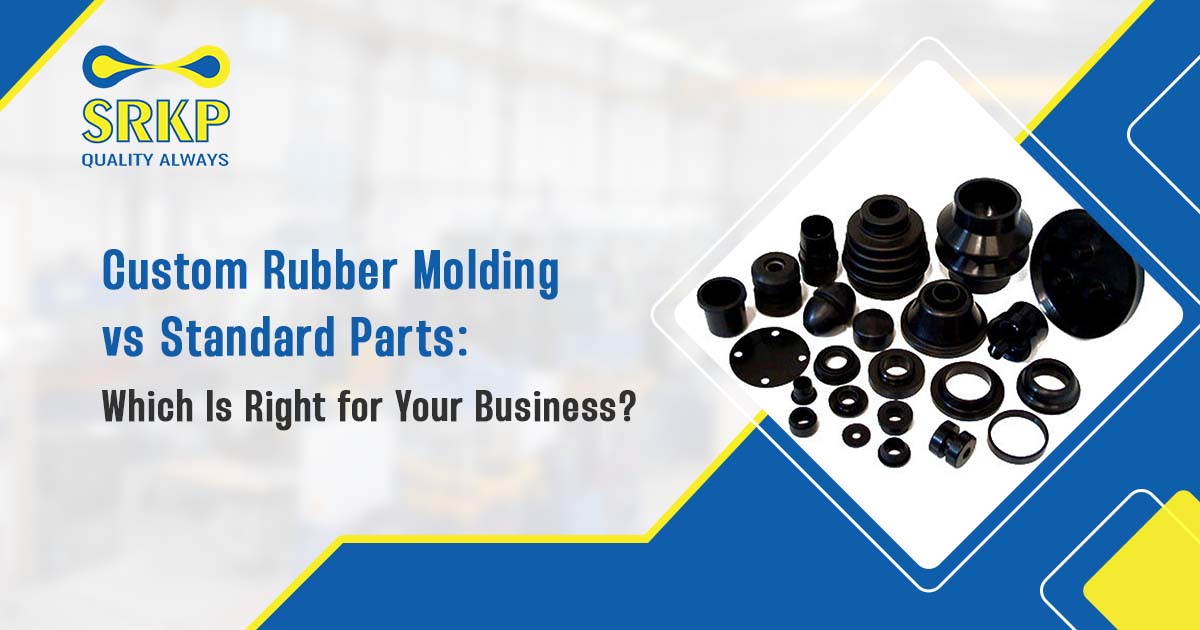
When you source rubber components for your industrial application, one of the most critical decisions you’ll face is this: should you opt for custom rubber molding or go with standard, off-the-shelf rubber parts?
It sounds straightforward, but the wrong choice can lead to performance failures, costly rework, supply chain disruptions, or even safety incidents especially in high-stakes industries like aerospace, defense, or oil and gas.
What Is Custom Rubber Molding?
Custom rubber molding is a manufacturing process in which rubber components are designed, compounded, and produced to meet the precise specifications of a particular application. Rather than selecting from a catalogue of existing shapes and sizes, engineers develop the component from scratch or adapt it significantly to match your exact dimensional, material, and performance requirements.
SRKP offers three primary custom rubber molding processes, all supported by our state-of-the-art moulding infrastructure:
Compression Molding — Operators place a rubber compound in a heated mold and compress it to fill the cavity. This method works ideally for medium-volume production and complex geometries.
Injection Molding — Workers heat rubber and inject it under high pressure into a closed mold. As a result, this process delivers excellent dimensional consistency and suits high-volume runs particularly well.
Transfer Injection Molding — A hybrid process where pre-plasticized rubber transfers into the mold. Consequently, manufacturers achieve tighter tolerances and reduce material waste.
Custom molding also encompasses specialized solutions such as metal-to-rubber bonding, fabric-impregnated diaphragms, Teflon-to-rubber bonding, and plastic-to-rubber bonding all of which are impossible to achieve with standard catalogue parts. Furthermore, our team validates these processes through a rigorous bonding validation protocol. Learn more about our full range of custom rubber molding capabilities
What Are Standard Rubber Parts?
Standard rubber parts are pre-manufactured components that factories produce in fixed shapes, sizes, and materials and sell directly from inventory. Common examples include O-rings in standard AS568 sizes, standard gaskets, plain rubber sheets, and generic seals.
Distributors make these parts widely available, and because manufacturers produce them in large volumes, procurement teams find them quick to source and generally lower in per-unit cost. However, engineers design them for general-purpose use not for your specific operating conditions.
Custom Rubber Molding vs Standard Parts: A Direct Comparison
| Factor | Custom Rubber Molding | Standard Rubber Parts |
|---|---|---|
| Fit & Function | Exact match to application | Approximate — may require workarounds |
| Material Flexibility | Any elastomer, any compound | Limited to catalogue options |
| Performance in Extremes | Engineered for your conditions | Designed for general conditions |
| Lead Time | Longer (tooling + development) | Immediate availability |
| Unit Cost | Higher (especially at low volumes) | Lower per unit |
| Long-Term Cost | Often lower (fewer failures, less waste) | Can be higher (repeated replacements) |
| Design Freedom | Full control over geometry and properties | Fixed dimensions only |
| Regulatory Compliance | Achievable (e.g., NSF 61, AS/NAS specs) | May not meet specific standards |
| Suitability for Critical Applications | High | Limited |
When Should You Choose Custom Rubber Molding?
1. Your Application Involves Extreme or Unusual Conditions
Standard rubber parts suit average conditions. However, if your application involves high temperatures, chemical exposure, high-pressure sealing, or dynamic mechanical stress, standard parts will degrade faster, fail unpredictably, or simply not perform.
For example, the oil and gas industry requires elastomers that resist aggressive hydrocarbons, H₂S, and extreme pressures. Therefore, SRKP formulates custom compounds using FKM (Viton), HNBR, and other specialty elastomers. According to ASTM rubber testing standards, material-specific validation is essential before deployment in high-pressure fluid handling environments.
2. You Need Non-Standard Dimensions or Geometries
Most machinery does not take shape around standard rubber part sizes it works the other way around. If your equipment calls for a seal, diaphragm, or gasket with unusual dimensions, a standard part will compromise your design. Moreover, custom molding allows SRKP to produce components to your exact drawing specifications, including complex cross-sections, bonded assemblies, and reinforced constructions all enabled by our in-house tooling and design infrastructure.
3. Regulatory or Industry Certification Is Required
Industries such as aerospace, defence, and water treatment often require components certified to specific standards NSF 61, AS/NAS aerospace specifications, or MIL-SPEC requirements. SRKP holds certification to produce components that meet these standards. Standard off-the-shelf parts, even if they appear similar, frequently lack the necessary material traceability or test documentation. You can review our full quality certifications and compliance credentials for more details.
4. Your Product Demands Long-Term Reliability
In critical applications a valve diaphragm in water distribution, a seal in a military vehicle, a grommet in an aircraft component failure is simply not an acceptable outcome. Therefore, custom rubber molded parts undergo engineering and validation specifically for your application lifecycle. SRKP’s in-house testing laboratory conducts physical and mechanical property testing, chemical resistance testing, and dimensional inspection to confirm that the part performs exactly as engineered before it reaches your facility.
5. You Are Designing a New Product or OEM Assembly
If you are an OEM developing a new product, you need rubber components that engineers design around your assembly not the other way around. Consequently, SRKP’s in-house R&D team works with OEM customers from the prototype stage through to mass production, ensuring the rubber component delivers optimum performance and manufacturability for your end product.
When Standard Rubber Parts Make Sense
Standard rubber parts are the right choice when:
- The application is non-critical and general-purpose — such as vibration dampening in light equipment or simple static seals in benign environments.
- Speed of procurement is the priority — for example, maintenance and repair scenarios where a machine is down and a standard O-ring or gasket will restore function immediately.
- Volume is very low and custom tooling investment isn’t justified — if you need just a handful of components for a prototype or trial, standard parts can bridge the gap while you validate your design.
- The component is a commodity item — if your application happens to align with a standard cross-section and material, there is no reason to invest in custom tooling.
Even in these scenarios, it is worth confirming that the standard part’s material compound matches your operating conditions not just its shape.
The Hidden Costs of Choosing Standard Parts in Critical Applications
Many businesses default to standard parts because the purchase price appears lower. However, this comparison rarely accounts for the true cost of ownership. Specifically, teams often overlook:
- Premature failures that lead to unplanned downtime and emergency maintenance
- Workarounds required because the part doesn’t fit perfectly, increasing assembly time and cost
- Repeated procurement cycles as shorter-lived standard parts need frequent replacement
- Performance degradation that affects the quality or safety of the end product
- Non-compliance risk in regulated industries where unvalidated parts create liability
Furthermore, research from the International Rubber Conference Organization shows that seal and gasket failures represent a disproportionate share of industrial downtime events despite the relatively low unit cost of these components. In high-value production environments, therefore, a single failure caused by an inadequate rubber component can cost far more than the entire investment in custom molding.
How SRKP Bridges the Gap: Tailored Rubber Manufacturing at Scale
SRKP is not simply a rubber parts vendor; we are a rubber engineering partner. Here is what distinguishes our approach:
In-House Rubber Compounding
Our in-house mixing and compounding plant, staffed by experienced rubber chemists, allows us to formulate compounds precisely suited to your application. We handle a broad range of elastomers, including EPDM, NBR, HNBR, FKM (Viton), Silicone, Fluorosilicone, CR (Neoprene), SBR, Polyurethane, and Polyacrylic. Over 35 years, our chemists have developed thousands of unique rubber compound recipes as a result of deep industry experience.
Advanced Tooling and Design
Custom rubber molding begins with precision tooling. Accordingly, SRKP’s tooling and design team develops molds that achieve the required dimensional accuracy, surface finish, and production efficiency for your component. We always develop prototype tooling first, which allows design validation before you commit to production tooling.
Rigorous In-House Testing
SRKP validates every custom component through our in-house laboratory. We conduct physical and mechanical property testing, bonding validation, chemical resistance testing, and dimensional inspection ensuring the part performs exactly as engineered before it reaches your facility.
Certifications That Inspire Confidence
SRKP holds multiple quality certifications, including ISO certification, UL NSF 61 certification for water treatment components, ZED Silver certification, and D-U-N-S registration. These certifications reflect the quality systems embedded in every stage of our manufacturing process not merely plaques on the wall.
Industry Applications: Custom Rubber Molding in Action
Aerospace and Defense
In aerospace, rubber components must perform reliably under extreme thermal cycling, fuel and hydraulic fluid exposure, and high-vibration environments. Accordingly, SRKP supplies custom-molded grommets, O-rings, seals, bellows, and gaskets to aerospace standards. In the defense sector, our components support equipment that must function in the most demanding environments imaginable.
Automotive
SRKP manufactures a comprehensive range of custom rubber parts for two-wheelers and four-wheelers oil seals, O-rings, holders, gaskets, grommets, and seals in compliance with international quality standards. Additionally, we use advanced compounding to deliver heat, oil, and ozone resistance.
Oil and Gas
Chemical resistance and pressure integrity are non-negotiable in oil and gas applications. Therefore, SRKP formulates specialty compounds that resist aggressive media and delivers custom seals, gaskets, and diaphragms that meet the stringent requirements of upstream and downstream operations.
Pumps and Valves
SRKP is a leading supplier to pump manufacturers, producing rubber bushes, balls, bearing bushes, bonded items, and flanges. For the valve industry, SRKP holds NSF 61 certification and manufactures wedges, diaphragms, and discs across a wide range of sizes with consistent quality. See our complete pump and valve rubber components catalogue for the full product range.
Power and Textile Industries
Our custom rubber products for power applications include dampers, mountings, hoses, bellows, and insulating mats. For the textile industry, we produce antistatic rubber components in specialized elastomers and custom colors.
Frequently Asked Questions (FAQs)
Q1: What is the minimum order quantity for custom rubber molded parts?
Minimum order quantities vary depending on the complexity of the component and the tooling involved. SRKP works with customers from the prototype stage, and our team advises on the most cost-effective production approach based on your volume requirements.
Q2: How long does it take to develop a custom rubber molded component?
Development timelines depend on component complexity. A straightforward component with simple geometry can move from concept to production in a few weeks. However, complex bonded assemblies or specialty diaphragms may require a longer development cycle. SRKP guides customers through the full prototype-to-production timeline from the outset.
Q3: Is custom rubber molding more expensive than standard parts?
The per-unit cost of a custom-molded part may be higher than a standard catalogue part, primarily due to tooling investment. However, when you account for fit, performance, longevity, and the risk of failure, custom molding typically delivers a lower total cost of ownership for critical applications.
Conclusion: Making the Right Choice for Your Business
The decision between custom rubber molding and standard parts ultimately comes down to risk, performance, and long-term value. Standard parts certainly have their place in non-critical, general-purpose, or emergency procurement scenarios. However, for any application where performance, compliance, longevity, or fit is critical, custom rubber molding is not a luxury it is a necessity.
SRKP brings over 35 years of rubber engineering expertise, advanced in-house capabilities, and a proven track record across aerospace, defense, automotive, oil and gas, power, pumps, valves, and textile industries. We don’t just manufacture rubber parts; we engineer rubber solutions. Contact our engineering team to discuss your specific application requirements today.


 PPTS
PPTS