
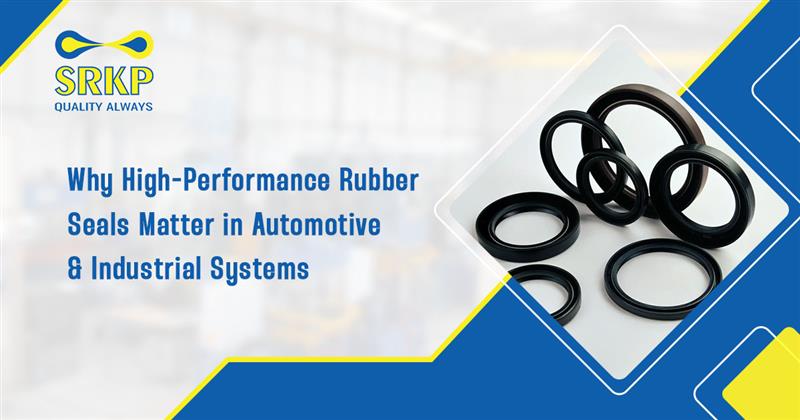
In the demanding B2B landscape of automotive manufacturing, heavy machinery, and industrial fluid systems, a failure in a single component can translate into crippling operational downtime and significant financial losses. Among the hundreds of parts that ensure a system’s integrity, the high-performance rubber seal plays a disproportionately critical role.
The performance of an entire system, be it a modern engine, a high-pressure pump, or an EV battery enclosure, rests on the ability of its seals to maintain a flawless barrier.
Procurement managers and design engineers are constantly challenged to specify seals that can withstand extreme thermal cycling, chemical exposure, and aggressive dynamic forces without succumbing to compression set or mechanical degradation.
The global automotive rubber seals market is projected to reach over $10.74 billion by 2032 (MarketsandMarkets), a growth largely driven by the shift towards electrification and the subsequent demand for highly durable, acoustically optimised sealing solutions.
When a seal fails, the cost is not merely the replacement part; it is the cost of warranty claims, fluid leaks, and, most critically, a compromised reputation for quality.
This makes the precise material and manufacturing choice for high-performance rubber seals an essential engineering and commercial decision.
Industry Problem / Technical Challenge: The High Cost of Seal Failure
In both the automotive and general industrial sectors, the fundamental challenge is managing containment and exclusion in dynamic, high-stress environments. Using a standard, general-purpose elastomer where a high-performance compound is required is a guaranteed path to premature system failure.
What happens when the wrong material is specified?
- Thermal Hardening and Embrittlement: In engine compartments (high heat) or systems exposed to frigid conditions (low temperature), a low-grade seal loses its elasticity, hardens, or becomes brittle. This leads to compression set, the seal’s inability to return to its original shape after deflection, resulting in leak paths for oil, coolant, or fuel.
- Chemical Degradation and Swelling: Seals exposed to aggressive media like synthetic oils, brake fluids, biodiesel, or corrosive industrial solvents will swell, shrink, or degrade chemically. For instance, standard NBR (Nitrile) might swell excessively when exposed to high-aromatic fuels, leading to loss of mechanical integrity and eventual seal blowout.
- Extrusion and Nibbling: In high-pressure hydraulic or pneumatic systems, an elastomeric seal with insufficient hardness or an improper gap design can be physically forced into the clearance between mating metal surfaces. This results in the characteristic ‘nibbling’ damage and catastrophic seal failure, leading to immediate system pressure loss.
The resulting downtime, a heavy earthmover sitting idle or a chemical plant line shutting down, magnifies the initial component cost by orders of magnitude. For the OEM, this directly impacts long-term warranty costs and brand reliability.
Technical Explanation of High-Performance Elastomers
A high-performance rubber seal is not simply rubber; it is a precision-engineered elastomeric compound formulated to perform predictably under specific extreme conditions. This involves selecting a base polymer and then custom-compounding it with cure-system additives, fillers, and plasticisers to achieve the required physical properties.
Key high-performance materials used for industrial and automotive sealing applications include:
- FKM (Fluoroelastomer / Viton®): Highly valued for its exceptional resistance to heat, oils, fuels, and a broad range of aggressive chemicals. It is a premier choice for high-temperature engine seals and oil & gas applications.
- HNBR (Hydrogenated Nitrile Butadiene Rubber): An upgraded version of NBR offering superior heat and oxidation resistance while maintaining excellent oil and fuel resistance. Essential in modern automotive systems where both high heat and contact with lubricants are present.
- VMQ (Silicone Rubber): Known for its extreme temperature flexibility, from very low to very high (e.g., -60 to +200). It is often used in static high-temperature applications where physical strength is not the primary requirement, such as electrical insulation and seals in EV battery packs.
- EPDM (Ethylene Propylene Diene Monomer): Excellent resistance to ozone, weathering, steam, and polar solvents (like brake fluids and water-based coolants). It is the material of choice for outdoor, non-oil exposed seals like automotive window and door weatherstripping.
Critical Properties of High-Performance Seals
The superiority of a high-performance seal is defined by its compliance with stringent technical specifications:
- Temperature Resistance: Ability to maintain elasticity and sealing force across a wide operational spectrum, from cryogenic temperatures to prolonged exposure over $200$.
- Chemical Stability: Resistance to volume changes (swelling or shrinkage) and chemical degradation when immersed in specific fluids (oils, acids, alkalis, coolants, or fuels).
- Electrical Insulation: Crucial in EV and electronics applications, where the material must prevent current leakage or provide an effective dielectric barrier.
- Tensile Strength & Tear Resistance: The ability to withstand stretching, tearing, and abrasive wear, particularly in dynamic sealing applications like rotating shafts and reciprocating rods.
- Durability (Low Compression Set): The most critical metric. It is the ability of the seal to recover its original thickness after being compressed and held at high temperature, ensuring the long-term maintenance of the sealing force.
- Cost-Effectiveness: Achieving the optimal balance between high performance and the total cost of ownership, where the seal’s extended lifespan drastically reduces maintenance and replacement costs.
Industry-Specific Applications for Precision Seals
The requirement for high-performance sealing is universal across all demanding industrial segments:
- Automotive:
- Engine & Powertrain: FKM O-rings, HNBR gaskets, and shaft seals in transmissions to handle high temperatures and complex synthetic lubricants.
- EV Systems: Custom-formulated Silicone and EPDM seals for battery pack enclosures and thermal management systems, providing IP-rated sealing and electrical insulation.
- Oil & Gas/Chemical Processing:
- Valves & Pumps: FKM, FFKM (Perfluoroelastomer), or custom HNBR compounds for seals in pipelines and processing equipment to resist sour gas, potent acids, and volatile hydrocarbons under high pressure.
- Heavy Machinery (Off-Highway):
- Hydraulic Cylinders: High-durometer NBR and Polyurethane (PU) seals for earthmovers, construction equipment, and tractors, designed to resist high system pressures and abrasion from external contaminants.
- Aerospace & Defence:
- Specialty fluorosilicone (FVMQ) and FKM seals for aircraft fuel systems and hydraulic actuators that must perform reliably under extreme pressure, vacuum, and temperature variations.
Material Comparison: FKM vs. HNBR for High-Temperature Sealing
When faced with a high-temperature, oil-contact application, engineers often weigh the benefits of FKM against HNBR. The selection hinges on the balance of thermal, chemical, and mechanical requirements.
Property | FKM (Fluoroelastomer) | HNBR (Hydrogenated Nitrile) |
Max Continuous Temperature | Up to 200 – 250 | Up to 150 – 170 |
Chemical Resistance | Excellent (Oils, Fuels, Hydrocarbons, Acids) | Very Good (Petroleum Oils, Aliphatic Hydrocarbons) |
Steam/Hot Water Resistance | Moderate/Poor | Excellent |
Abrasion Resistance | Good | Excellent |
Compression Set | Excellent (Low Set at high temp) | Very Good |
Cost Profile | High | Moderate-High |
Typical Use Case | Engine head gaskets, fuel injector seals, and chemical processing pumps. | Automotive AC systems, oil well seals, heavy-duty gearboxes. |
This comparison highlights that while FKM offers superior overall thermal and chemical stability, HNBR is often chosen when a balance of high-temperature resistance and exceptional abrasion resistance is required, offering a more cost-effective solution in specific industrial contexts.
Why Choosing the Right Manufacturer Matters
The performance of a rubber seal is not solely a function of its base polymer; it is a direct consequence of the compounding, moulding precision, and quality control of the manufacturer. For OEMs and procurement managers, partnering with a certified, quality-driven supplier is non-negotiable for system reliability.
A reliable manufacturer must offer:
- Custom Compounding Expertise: The ability to fine-tune the elastomer recipe, adjusting crosslink density, fillers, and curatives, to meet precise client specifications for compression set, fluid resistance, and durometer (hardness).
- Dimensional Accuracy: High-precision moulding is essential for O-rings and dynamic seals to ensure the correct squeeze and gap filling. Tolerances must comply with international standards like ISO 3601 or IS 3400.
- Accredited Quality Systems: Compliance with sector-specific certifications is mandatory. ISO 9001:2015 ensures a consistent quality management system, while IATF 16949 is the global technical specification for quality management systems in the automotive sector, proving a manufacturer’s commitment to defect prevention and supply chain risk reduction.
Why SRKP Is the Right Partner for High-Performance Rubber Seals
SRK Polymers (SRKP) is a leading Indian rubber component manufacturer built on the foundation of engineering excellence. We understand that in the B2B manufacturing domain, reliability is the ultimate specification.
- Advanced R&D Capabilities: Our in-house material science lab specialises in custom elastomeric compounding, allowing us to engineer polymers that precisely match the unique thermal, chemical, and pressure environments of your application. We don’t just supply standard seals; we engineer sealing solutions.
- Custom Compounding for Indian Industrial Context: We formulate compounds specifically for the diverse and challenging operating conditions across the Indian subcontinent, from the high ambient temperatures in the South to the extreme cold of the North, and the challenging fuel and lubricant variations across the market.
- In-house Testing & Quality Control: Every batch undergoes rigorous testing for key parameters, including Compression Set, Tensile Strength, Elongation at Break, and Fluid Immersion/Swelling tests. This meticulous quality gate ensures product consistency and performance predictability.
- Scalability & Delivery Confidence: Our state-of-the-art moulding facilities are equipped to handle high-volume production for large OEMs while maintaining the precision required for low-tolerance, complex geometries. We deliver quality at scale.
- Automotive-Grade Compliance: Our operations adhere strictly to the demanding quality standards of the automotive industry, providing you with seals that meet and often exceed IATF-level requirements for your critical systems.
- Proven Reliability: Decades of partnering with major Indian and global OEMs stand as a testament to our commitment to producing components that do not fail when it matters most.
Conclusion
The decision to procure high-performance rubber seals is an investment in the longevity, safety, and efficiency of your finished product or industrial plant. Moving beyond commodity-grade components is no longer an option but a technical necessity driven by higher operating temperatures, aggressive new fluids, and the zero-defect demands of industries like EV and heavy machinery.
By focusing on certified manufacturing partners who can provide scientifically validated, custom-compounded elastomeric seals, OEMs and procurement professionals can mitigate system risks, drastically reduce warranty claims, and secure their reputation for delivering robust, high-quality products to the market.
Your growth needs the right rubber partner, connect with SRK Polymers today to build reliable, high-performance rubber components for your industry needs.


 PPTS
PPTS