
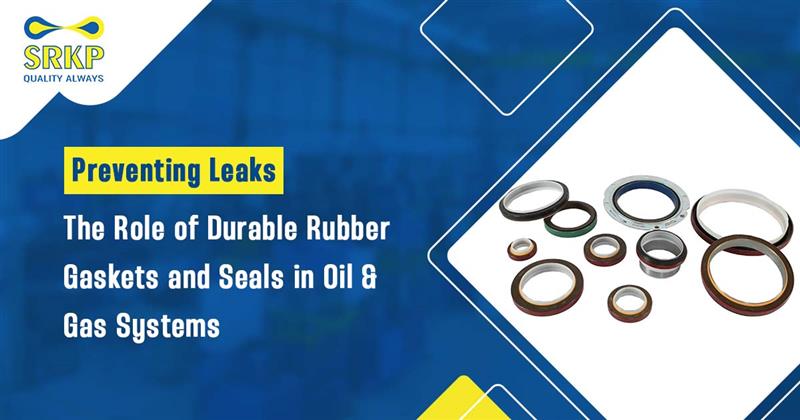
In the demanding world of Oil & Gas Systems, where pressures soar, temperatures swing, and fluids are often corrosive, even a minor leak can trigger serious consequences.
Pipelines, pumps, and valves get most of the spotlight. But behind every safe and efficient operation lies a network of small, powerful protectors, and they are rubber Gaskets and Elastomer Seals.
These High-Performance Rubber Components are the quiet enforcers of system integrity, ensuring that operations remain leak-free from drilling rigs to refining plants.
They’re not optional. They’re indispensable to the performance and safety of every system they serve. Let’s understand their importance in the industry and our expertise in this blog.
The Real Cost of Leakage: Why Durability Matters
In Oil & Gas, leaks mean more than a maintenance issue; they’re direct hits to safety, efficiency, and reputation.
- Financial Losses: A single unplanned shutdown due to seal failure can cost thousands of dollars in lost production.
- Environmental Risk: Leaks can contaminate land and water, leading to heavy penalties and long-term cleanup obligations.
- Operational Downtime: A failed gasket or seal interrupts flow, damages equipment, and delays output.
No surprise then that the global oil and gas processing seals market is projected to reach $8.75 billion by 2032. The industry understands that investing in durable sealing solutions is cheaper and smarter than managing failure.
To keep up this promise, we produce first-quality rubber products in India, and we are helping global companies to maintain a safe workplace.
The Role of Rubber Gaskets in System Integrity
Every joint, flange, and valve is a potential point of failure. Rubber Gaskets serve one fundamental purpose: to create a leak-tight seal between rigid components.
They absorb irregularities, resist pressure changes, and maintain system stability under vibration and shock. Without them, even the strongest pipeline design becomes vulnerable to micro-leaks and contamination.
In essence, they act as the final layer of assurance, a small part with massive responsibility.
Why are Rubber Gaskets more suited to the system?
Picture a Rubber Gasket as the invisible barrier that makes a window airtight.
- Metal Flanges are your window frames, strong but never perfectly flat.
- Oil, Gas, or Process Fluid behaves like wind or water, always trying to escape.
- The Durable Rubber Gasket is that flexible, adaptive lining that seals every microscopic gap and ensures nothing passes through.
It’s the same principle: flexible strength compensating for rigid imperfection.
The result? No leaks, no intrusion, no compromise.
Where Are Rubber Gaskets Used in Oil & Gas Systems?
Rubber sealing components appear across every stage of the oil and gas value chain:
- Upstream: Drilling rigs, blowout preventers, and wellhead equipment rely on elastomer seals to handle high pressure and exposure to drilling fluids.
- Midstream: In pipelines and compressors, durable gaskets maintain pressure integrity during long-distance transport.
- Downstream: Refineries use specialized seals to contain chemicals, hydrocarbons, and steam under fluctuating temperatures.
Each environment demands a unique compound formulation, one that resists both the media and mechanical stress. That’s where material science and precision engineering converge.
The Material Science Behind High-Performance Sealing
Ordinary rubber can’t survive in these environments. Heat, pressure, and chemicals attack its structure, leading to swelling, softening, or hardening.
Durable performance comes from specialized elastomer compounds engineered to resist multiple destructive forces simultaneously.
Challenge in Oil & Gas | Why Durable Rubber Is the Solution | SRKP Material Examples |
High Heat & Pressure | Elastomers like FKM/Viton and FFKM retain elasticity and resist compression set under high loads. | Viton (FKM), Silicone-based compounds |
Aggressive Chemicals | Nitrile (NBR) and Viton resist sour gas, drilling fluids, and hydrocarbon solvents. | Nitrile (NBR), Neoprene |
Dynamic Vibration | Rubber’s elasticity dampens vibration, preventing micro-leaks that can develop over time. | Custom Rubber-Moulded Products |
By combining flexibility, chemical resistance, and mechanical strength, SRKP’s materials deliver long-term sealing reliability across all operational extremes.
How Design Precision Influences Performance
A high-quality material isn’t enough on its own. Gasket and seal performance depend heavily on precision engineering and how accurately each component fits within the system.
Even the best rubber compound can fail if it’s not designed for the right load, compression, or temperature range. SRKP’s engineering process focuses on:
- Accurate material selection for the target pressure and fluid type.
- Controlled curing and molding to achieve consistent elasticity.
- Exact dimensional tolerances to ensure a perfect seal fit.
This precision ensures that seals perform predictably, reducing both risk and replacement frequency.
The Evolution of Elastomer Technology in Oil & Gas
Modern sealing science has evolved far beyond traditional rubber. Today’s high-performance elastomers are built to withstand the harshest environments, including sour gas fields and deep-water extraction zones.
Innovations like Rapid Gas Decompression (RGD)-resistant compounds and fluorocarbon-based polymers have changed the reliability equation. These materials maintain flexibility at high temperatures and don’t crack under fluctuating pressure cycles.
As the industry shifts toward deeper wells and more aggressive fluids, SRKP’s advanced rubber formulations are designed to deliver consistent sealing where conventional materials fail.
Selecting the Right Partner for Rubber Components
The strength of your system depends on the strength of your seals and the expertise behind them.
Selecting the right manufacturing partner isn’t just about buying parts; it’s about aligning with a supplier that understands application-specific challenges.
At SRKP, our process ensures reliability from material design to final production:
- Precision Engineering: Every gasket and seal is produced to meet international quality standards such as UL 157.
- High-Performance Materials: Advanced compounds with proven resistance to RGD, heat, and chemical exposure.
- Tailored Solutions: Custom rubber-moulded products designed to address your unique pressure, temperature, and media conditions.
This is how SRKP ensures that your critical equipment operates seamlessly, even in the most demanding environments.
The Future of Leak Prevention in Oil & Gas
With the industry’s growing focus on sustainability and operational efficiency, leak prevention will only become more critical.
Advanced sensors, real-time monitoring, and predictive maintenance are now standard, but none of them can compensate for a poor seal. The foundation of reliability still lies in material integrity.
That’s why SRKP continues to innovate in rubber compounding and precision molding, enabling energy companies to operate safely, efficiently, and sustainably for years to come.
Final Takeaway
A single failed seal can compromise an entire system.
Investing in Durable Rubber Gaskets and Elastomer Seals is the smartest move any Oil & Gas operation can make for performance, safety, and environmental compliance.
From design to delivery, SRKP’s engineered rubber components protect your operations, prevent leaks, and extend the life of your most critical systems.
Looking to strengthen the integrity of your Oil & Gas systems?
SRKP provides custom-engineered sealing solutions built to perform, no matter how tough the environment.


 PPTS
PPTS